

 Français
Reverse charge VAT invoice: the guide for e-commerce
Master the reverse charge VAT invoice. Our complete guide explains how to issue it, account for it and automate it for your online store.
A reverse charge invoice is simply an invoice issued without VAT. Why? Because the tax mechanism is reversed. It’s no longer the seller who collects the tax, but the buyer who calculates and declares it directly to the State. This system, often called “reverse charge,” considerably simplifies international B2B transactions.
A deep dive into how VAT reverse charge works

At first glance, the concept of VAT reverse charge can seem a bit abstract. Yet the basic idea is very simple: the responsibility for collecting VAT is transferred from the supplier to the customer. It’s the opposite of the classic scheme, where the seller charges VAT, collects it, and then diligently remits it to the Treasury.
Let’s take a concrete example. Imagine you run an e-commerce store and buy your stock from a supplier in Germany. Without reverse charge, that supplier would need to register for VAT in France, invoice with French VAT, and declare it here. A genuine administrative headache that would seriously slow down trade.
Reverse charge is a pragmatic solution: it makes the buyer, also called the “recipient,” directly responsible for the VAT on their purchase. In a sense, they become their own tax collector for that specific transaction.
This mechanism is absolutely essential for smoothing trade within the European Union, and beyond. It ensures that VAT is properly paid in the country where the good or service is consumed, while easing the administrative burden for foreign businesses.
The table below summarizes the benefits of this system for both parties involved in an international transaction.
Benefits of reverse charge for international B2B transactions
| Party involved | Main benefit | Concrete impact |
|---|---|---|
| French buyer | Simplicity when buying abroad | Receives a net-of-VAT invoice, handles VAT through their own return with no cash outlay. No need to claim a refund of foreign VAT. |
| Foreign seller | Easier access to the French market | Doesn’t need to register for VAT in France or handle French tax returns for their B2B sales. |
This win-win system is at the heart of simplifying the European single market.
The principle of “reversal of the taxable person”
The administrative jargon calls this the “reversal of the taxable person.” In concrete terms, when you receive a reverse charge invoice, it shows a total net-of-VAT (excl. tax) amount. It’s up to you, the French buyer, to play your part:
- Calculate the VAT: You must apply the current French VAT rate (generally 20%) to the net amount of the invoice.
- Declare the VAT: On your VAT return (the well-known CA3 form), you’ll enter this amount in two places: once in the “VAT collected” box and once in the “deductible VAT” box.
For most businesses with full deduction rights, the operation is a wash, financially neutral. The “due” VAT is immediately offset by the “deductible” VAT. The impact on your cash flow is therefore nil. The key is not to forget this set of accounting and reporting entries.
Why is this a crucial topic for online sellers?
For an e-commerce business, reverse charge isn’t a distant tax notion. It’s an almost daily reality. Whether you sell via Shopify, Amazon or your own website, you’re constantly facing international transactions:
- Stock purchases from European suppliers.
- Advertising spend on platforms like Meta or Google, often billed from their headquarters in Ireland.
- Software subscriptions to foreign SaaS tools to run your store, marketing or logistics.
Each of these B2B transactions is almost systematically subject to VAT reverse charge. Ignoring or misunderstanding this mechanism exposes you to reporting errors, costly omissions and, ultimately, tax penalties.
To fully understand the legal basis, feel free to check out our article breaking down Article 283 of the French Tax Code on VAT reverse charge. Mastering this system is an essential skill for securing the management of your business and ensuring compliance.
In which concrete cases does reverse charge apply for an online seller?
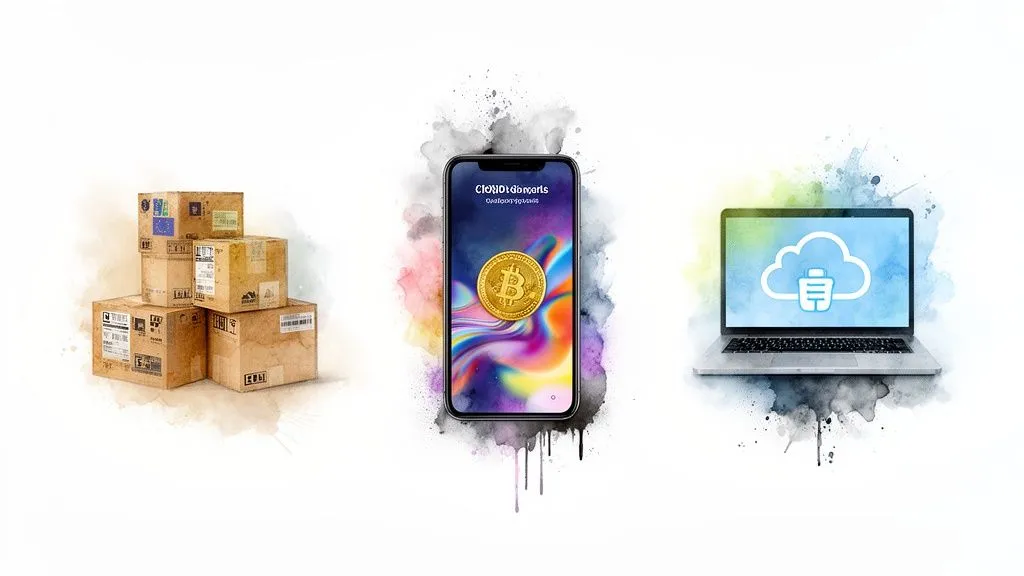
For an e-commerce business, VAT reverse charge is anything but an abstract tax concept. It’s a daily reality, far more common than you might think. The first step to staying compliant is knowing precisely how to spot the transactions it applies to.
Far from being an exception, this mechanism affects entire swaths of your business, from purchasing goods to your advertising spend. Understanding these scenarios well lets you master your reporting obligations and avoid costly mistakes.
Let’s look together at three major situations where a reverse charge invoice is the norm for any online selling business.
Intra-community acquisitions of goods
This is the textbook case for any e-commerce business. Do you buy your stock or raw materials from a supplier based in another European Union country? Then you’re right in the thick of it. Whether you sell via Shopify, Amazon or your own website, chances are you source from Germany, Spain or Italy.
The rule is simple: when a VAT-registered French business buys products from another VAT-registered business in a Member State, this is called an intra-community acquisition. Your European supplier must then invoice you without VAT.
- Your supplier checks the validity of your intra-community VAT number and sends you a net-of-VAT invoice.
- On your side, as the buyer, you must calculate the French VAT on this amount and declare it to the tax authorities via your CA3 return.
To make it clearer: Your Shopify store buys €5,000 worth of products from a wholesaler in Portugal. They send you an invoice for €5,000 excl. VAT. On your VAT return, you’ll calculate the French VAT amount (20%), i.e. €1,000, which you’ll enter both as VAT collected and as deductible VAT. Result: the transaction is entirely neutral for your cash flow.
This system has the merit of simplifying trade by sparing your Portuguese supplier the hassle of dealing with the intricacies of French VAT.
International B2B services
This scenario is almost universal for any online business today. It covers all expenses related to services provided by companies based abroad, whether within the EU or elsewhere.
Just think of your recurring invoices:
- Online advertising: Invoices from Meta (Facebook, Instagram) or Google Ads generally come from their headquarters in Ireland. They’re therefore issued without VAT and must be reverse-charged.
- Software subscriptions (SaaS): Your email marketing tool, project management platform or design software is often billed by an American, Irish or other foreign company.
- Marketplace commissions: If you sell on a platform whose parent company is based abroad, its service fees follow the same logic.
In each of these situations, the provider invoices you net of VAT. It’s up to you to calculate and declare the corresponding VAT in France. Forgetting this step is one of the most common errors, and one of the most easily flagged by the tax authorities.
The specific case of subcontracting
A little less obvious, but just as crucial, the reverse charge mechanism also applies in the subcontracting sector. This is a common scenario for fast-growing D2C brands that outsource part of their production or services. When a business (the principal) entrusts work to a subcontractor in France, it’s the principal who must account for the VAT.
The subcontractor issues an invoice excl. VAT, adding the mention “reverse charge.” The client business, in turn, declares the VAT on its own return. For example, for a €10,000 excl. VAT service, this represents €2,000 of VAT to be reverse-charged. This mechanism is above all a tool to combat VAT fraud, a colossal shortfall estimated at €9.5 billion in France. The upcoming e-invoicing reform aims to further strengthen this control. To learn more, you can consult this guide on VAT reverse charge and its subtleties.
Knowing how to identify these situations is a key skill for any business owner. Fortunately, tools like Bizyness, connected to your sales platforms and bank accounts, can automate this detection, generate the right accounting entries and secure your tax compliance without you having to think about it.
How do you issue a reverse charge invoice that’s fully compliant?
Writing an invoice seems simple. Yet a small mistake on a reverse charge invoice can quickly turn into an administrative headache, or even a tax penalty. To stay at ease, every detail matters. The logic is simple: since you’re transferring VAT responsibility to your client, your invoice must give them everything they need to declare it correctly.
A properly drafted invoice isn’t just a commercial document. It’s above all legal proof. In the event of an audit, this is the document that will justify why you didn’t collect VAT. Think of it as your shield, proof that you followed the rules.
The mandatory mentions you must never forget
For a reverse charge invoice to be valid, it must include a few specific mentions in addition to the usual information (date, number, identity of the parties, etc.). A single omission and the entire invoice could be called into question.
Here are the three pillars of a rock-solid reverse charge invoice:
-
Intra-community VAT numbers: Yours, of course, but above all your client’s. This is the key element proving that the exchange is indeed taking place between two VAT-registered businesses within the European Union, justifying the use of this mechanism.
-
Total absence of VAT: Your invoice must be crystal clear. It must show amounts excl. VAT, and the total to be paid must exactly match that net amount. Neither a VAT rate nor a VAT amount should appear.
-
The legal mention, in black and white: This is the crucial point. You must explicitly state that the transaction is subject to reverse charge. This sentence officially informs your client that they are now liable for the tax.
The standard wording is simple but remarkably effective: “Reverse charge by the recipient” or simply “Reverse charge.” For a supply of goods, the more formal mention is: “VAT exemption, Article 262 ter I of the French Tax Code.” To dig deeper into the topic, you can consult our complete guide on the VAT reverse charge mention.
These elements aren’t mere suggestions — they’re the foundation of your tax compliance.
The impact of e-invoicing
Get ready, because the way you invoice is about to change radically with the arrival of mandatory e-invoicing in France. This reform, which will roll out between 2026 and 2027, has a direct impact on managing reverse charge invoices.
From September 1, 2026, all businesses will need to be able to receive electronic invoices. SMEs will have until September 1, 2027 to issue them. For a reverse charge transaction, typical for an Amazon FBA seller sourcing outside France, the electronic invoice will need to include specific fields for the “reverse charge” mention and the client’s VAT number. The goal? To facilitate pre-filling of VAT returns. To learn more, the official documentation on the reform is a good resource.
This digital shift aims to simplify life for businesses, but also to fight more effectively against fraud, which represents a shortfall of €9.5 billion a year in France.
Checklist of mandatory mentions for a reverse charge invoice
To help you avoid forgetting anything, we’ve prepared a table summarizing the points to check before sending your invoice. Think of it as your final check before takeoff.
| Mandatory mention | Example or explanation | Risk if omitted |
|---|---|---|
| Client’s intra-community VAT number | Must be valid. Remember to check it against the European Commission’s VIES database. | The transaction may be reclassified as a taxable sale, triggering a VAT reassessment. |
| ”Reverse charge” mention | State “Reverse charge by the recipient” or reference the relevant article of the Tax Code. | Tax fine and the VAT exemption being called into question. |
| Amounts shown excl. VAT | The total to be paid must be the net-of-VAT amount. No VAT. | Confusion for the client, who risks an error in their return (and so do you). |
| Full identities | Name, address, SIREN of the seller and the buyer. | The invoice is non-compliant and may be rejected by the client’s tax authorities. |
By following these rules to the letter, you secure your transactions and can rest easy. Tools like Bizyness go further by automating the creation of these invoices: they systematically include the right mentions and verify the information for you. Compliance, without having to think about it.
Mastering VAT accounting and reporting
Correctly applying reverse charge in your accounting isn’t just good practice, it’s an obligation. Fortunately, the mechanism is much simpler than it looks. The goal is to make the transaction completely neutral for your cash flow, while ensuring VAT is properly declared to the State.
The secret? A set of entries that cancel each other out. The VAT you’re supposed to collect on your purchase is immediately offset by the right to deduct it. It’s a financially neutral operation, but essential from an accounting standpoint.
The accounting entries for reverse charge
Specifically, when you receive a reverse charge invoice, your accounting must record two VAT movements at the same time:
- VAT collected: you credit a VAT-due account. For a purchase within the EU, this will often be account 4452 “Intra-community VAT due.”
- Deductible VAT: simultaneously, you debit a deductible VAT account, for example account 445662 “Deductible VAT on intra-community acquisitions.”
For most businesses, the two amounts are strictly identical. One offsets the other. The impact on your cash flow is therefore nil, but this double entry is essential for the traceability of the transaction in the eyes of the tax authorities.
VAT reverse charge is a key mechanism for French businesses, especially those selling online, like e-commerce merchants on Shopify or Amazon. Imagine a purchase of €1,000 excl. VAT from a European supplier: you must reverse-charge €200 of VAT (at the 20% rate). Skipping this step exposes you to a fine of 5% of the amount omitted.
How to correctly report it on the CA3 form
Even though the transaction costs you nothing, it must absolutely appear on your VAT return, the well-known CA3 form. This is where the tax authorities check that you’re playing by the rules.
On this form, it’s crucial to enter the amounts in the right boxes so everything balances out.
For example, for an intra-community acquisition, you’ll enter the net amount of your purchase on line 03, “Intra-community acquisitions.” The form will then automatically calculate the corresponding VAT. This VAT will be added to your VAT collected, but you’ll be able to deduct it further down, making the transaction neutral.
This little diagram nicely summarizes the essential checkpoints on an invoice subject to this regime.
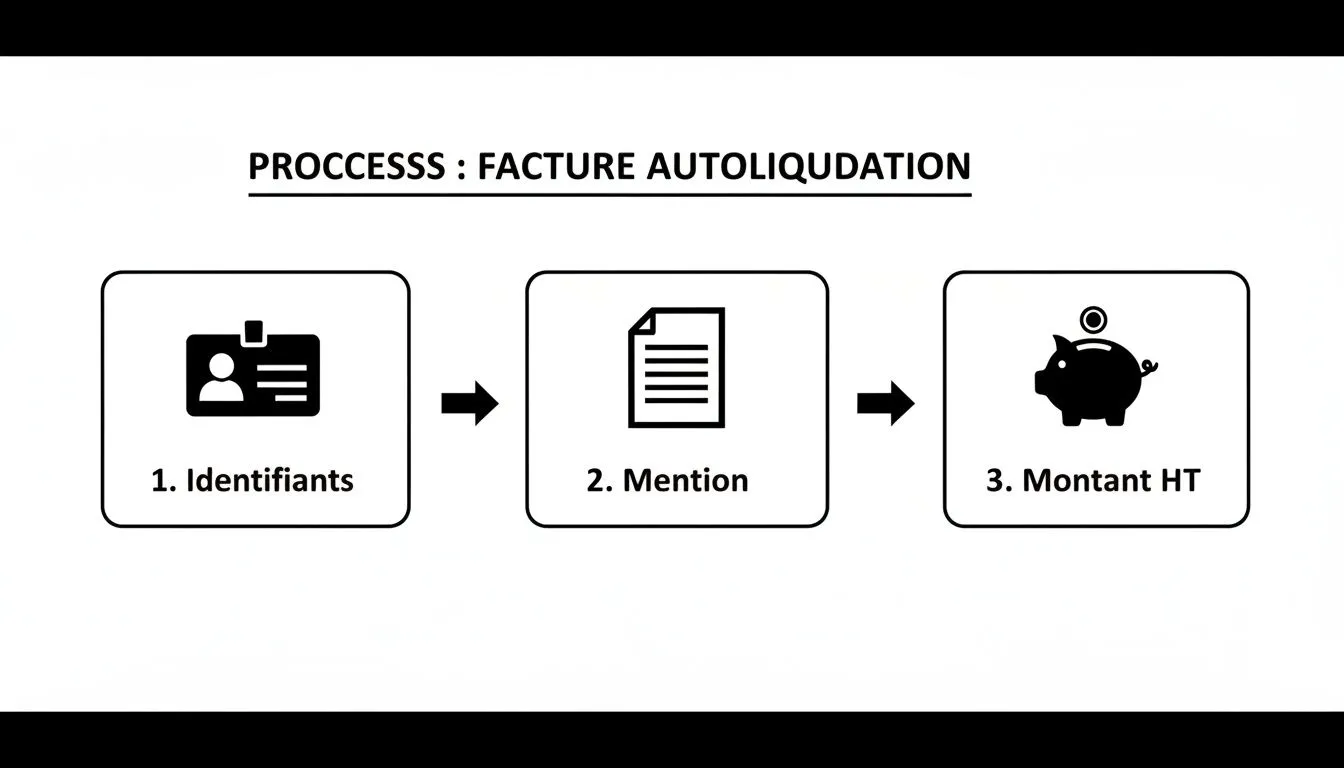
This simple flow highlights the importance of checking VAT numbers, entering the correct legal mention, and invoicing only net of VAT. To go further, our article on calculating intra-community VAT is an excellent resource.
Automation, the key to peace of mind
Handling these entries and returns manually is not only a waste of time, it’s also taking the risk of making mistakes. One omission, one figure swapped, and you draw the attention of the tax authorities. This is exactly where tools like Bizyness become real allies.
By connecting to your sales platforms (Shopify, Amazon) and your payment solutions (Stripe, PayPal), Bizyness automatically identifies transactions that require reverse charge. It then generates the offsetting accounting entries, with nothing for you to do.
The result? Reliable accounting, considerable time savings, and guaranteed tax compliance. You can finally focus on what really matters: growing your e-commerce business, with peace of mind.
Automating reverse charge management with Bizyness
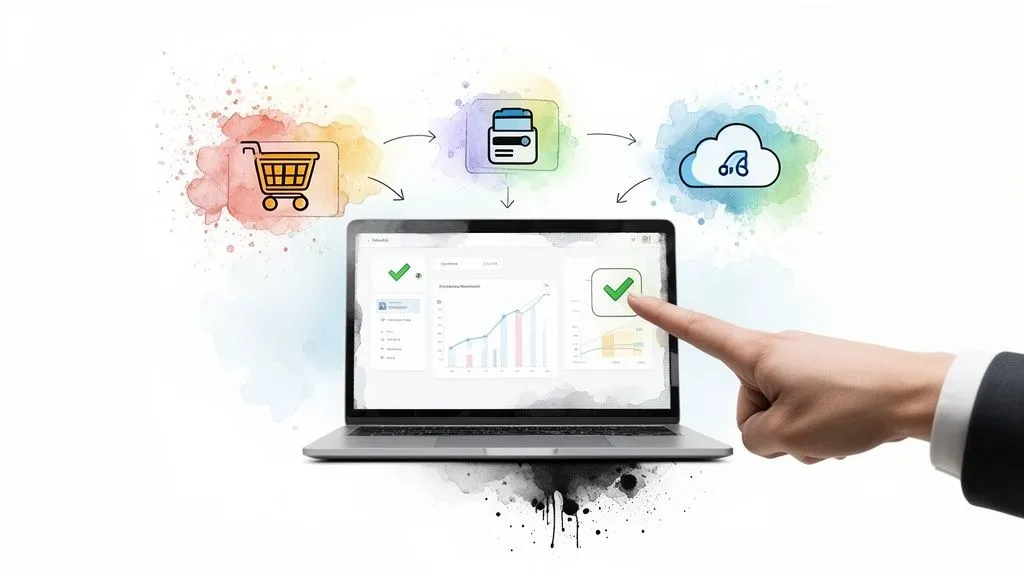
Manually managing every single reverse charge invoice is quite the obstacle course for a business owner. Every invoice from a European supplier, every ad expense on Meta or Google, every subscription to a foreign software tool has to be spotted, checked, then processed in the books. It’s a source of constant stress, where the risk of error can be costly in penalties.
Faced with this complexity, automation is no longer a mere option — it’s a necessity to secure your business and its growth. That’s precisely Bizyness’s mission: turning these repetitive, risky tasks into a smooth, fully reliable process.
Managing reverse charge goes beyond simple accounting. It’s a matter of peace of mind. By automating, you don’t just save time — you eliminate the constant nagging doubt about tax compliance.
By simply connecting your tools (e-commerce, payments), you let the platform take over. The promise is clear: you focus on what you do best, while the tax machinery runs smoothly in the background, without a hitch.
How does it work? Automatic transaction identification
The first step, and arguably the most critical, is spotting every transaction subject to reverse charge. This is where the magic of Bizyness’s integrations comes in. Once you’ve connected your Shopify, Amazon, Stripe or PayPal accounts, the platform starts continuously scanning your financial flows.
It doesn’t just see money going out. Bizyness identifies the supplier’s origin, checks whether they’re based abroad, and distinguishes between an acquisition of goods and a supply of services.
- Advertising expenses: Invoices from Meta, based in Ireland, are instantly recognized.
- Stock purchases: An invoice from a German wholesaler is immediately tagged as an intra-community acquisition.
- SaaS subscriptions: Payments for American software tools are also detected and correctly categorized.
This smart recognition spares you the tedious manual sorting of your purchase invoices. The system does the work for you, 24/7, and makes sure no transaction slips through the cracks.
Generating accounting entries, effortlessly
Once a transaction is identified, the second phase kicks in: generating the accounting entries. This is where the time savings and security become tangible.
Bizyness automatically applies the correct French VAT rate (usually 20%) to the net amount of the invoice. It then generates the set of entries that neutralizes the transaction for your cash flow, exactly as required by the tax authorities.
- VAT calculation: The platform applies the 20% rate (or the applicable reduced/intermediate rate) to the invoice amount.
- Creating the VAT collected entry: An entry is posted to the credit of the VAT-due account (for example, account 4452).
- Creating the deductible VAT entry: Simultaneously, an entry is posted to the debit of the deductible VAT account (for example, account 445662).
This process is fully automated. No more headaches over account numbers or fear of forgetting one of the two entries. The platform guarantees the consistency and compliance of your accounting, plain and simple.
What’s the concrete benefit for your business?
The impact of this automation is direct and measurable. Beyond simple compliance, it’s your entire business management that levels up.
The first benefit is tax peace of mind. You have the certainty that every reverse charge invoice is handled by the book, which drastically reduces the risk of a reassessment in the event of an audit. That’s a peace of mind that’s priceless.
The second benefit is real-time financial visibility. Your accounting data is always up to date. You get a clear, precise picture of your profitability and expenses, without having to wait for the year-end close.
Finally, and perhaps most importantly, you free up precious time. The time you used to spend tracking, checking and recording these transactions can now be reinvested where it has the most impact: developing your products, refining your marketing or pampering your customers. With Bizyness, the complexity of reverse charge becomes just a well-oiled cog serving your growth.
Your frequently asked questions about reverse charge invoices
Even once you’ve grasped the principle well, very concrete questions about reverse charge invoices always end up coming up. That’s perfectly normal. The idea here is to answer the most common situations directly, to clear up any remaining doubts so you feel completely at ease.
Think of this section as a toolbox of quick answers. The goal is simple: to give you the right reflexes to handle these situations without stress and, above all, in full compliance.
My supplier charged VAT by mistake, what should I do?
This is a classic, especially when working with new partners. Imagine: a European supplier sends you an invoice for a transaction that should be subject to reverse charge, but they added their own country’s VAT. The first reflex is crucial: do not pay that VAT.
Here’s how to proceed, calmly and methodically:
- Contact your supplier right away: Simply explain that for a B2B transaction between two EU countries, the reverse charge mechanism applies and that their invoice is therefore incorrect.
- Request a corrected invoice: The supplier must cancel the first invoice and send you a new one. It must be net of VAT and carry the “Reverse charge” mention, with your intra-community VAT number clearly visible.
- Don’t get bogged down in foreign VAT: Paying that VAT would force you to launch a refund procedure with the tax authorities of the country concerned. Believe me, that’s often a long and complicated ordeal.
You really need to act fast. If you pay the invoice as is, you expose yourself to a double problem: you risk never seeing the foreign VAT you paid for nothing again, and on top of that, you still owe the VAT in France via the reverse charge you should have applied. In short, you’d be paying twice.
How do I get an intra-community VAT number?
This number is a bit like your passport for trading in Europe. Without it, no reverse charge is possible, it’s as simple as that.
Fortunately, obtaining one is generally quite simple.
-
If your business is already VAT-registered (under the standard or simplified regime): Good news, you don’t have to do anything. The Business Tax Office (SIE) automatically assigns you this number upon registration. It consists of the “FR” code, a two-digit key, and your SIREN number.
-
If you’re under the VAT exemption scheme (the case for micro-entrepreneurs, for example): You don’t have one by default. You must expressly request one from your SIE as soon as you start making purchases or selling services to businesses in the EU. Rest assured, this step doesn’t call into question your exemption for your sales in France at all.
One last tip: once you have it, get into the habit of always checking the validity of your European partners’ VAT numbers via the VIES online service provided by the European Commission. It’s a quick check that will save you a lot of trouble.
How do I handle reverse charge for digital services?
For everyone selling online, digital services are daily bread and butter: ads on Meta or Google, SaaS software subscriptions, marketplace commissions… The rule is clear: these B2B services, when they come from abroad, are almost always subject to reverse charge.
The mechanism doesn’t change. You’ll receive an invoice without VAT, and it’s up to you to calculate the French VAT and report it on your CA3 return. Since you can deduct it at the same time, the impact on your cash flow is nil.
The real trap is volume. We’re often talking about many small invoices, and it’s very easy to forget one. But these small omissions, added up, can quickly amount to a substantial sum that won’t fail to attract attention in the event of a tax audit. Automation then becomes your best friend to make sure nothing slips through the cracks.
Navigating the details of reverse charge is logical, but it can quickly become a nightmare to manage manually. Bizyness was designed to free you from this mental load. Our platform automatically spots transactions to be reverse-charged, posts the right entries, and makes your returns reliable. You gain peace of mind and time to focus on what really matters: your business. Discover how Bizyness can simplify your accounting today.
