

 Français
Sole trader charges calculation: the complete guide
Sole trader charges calculation made simple. Master your social contributions, taxes and VAT with concrete examples and practical advice.

The micro-entrepreneur (sole trader) system was designed to be simple: you apply a fixed percentage to your actual collected revenue, and that’s it. This approach lets you know exactly what you owe, without getting lost in endless calculations.
Understanding your charges at a glance
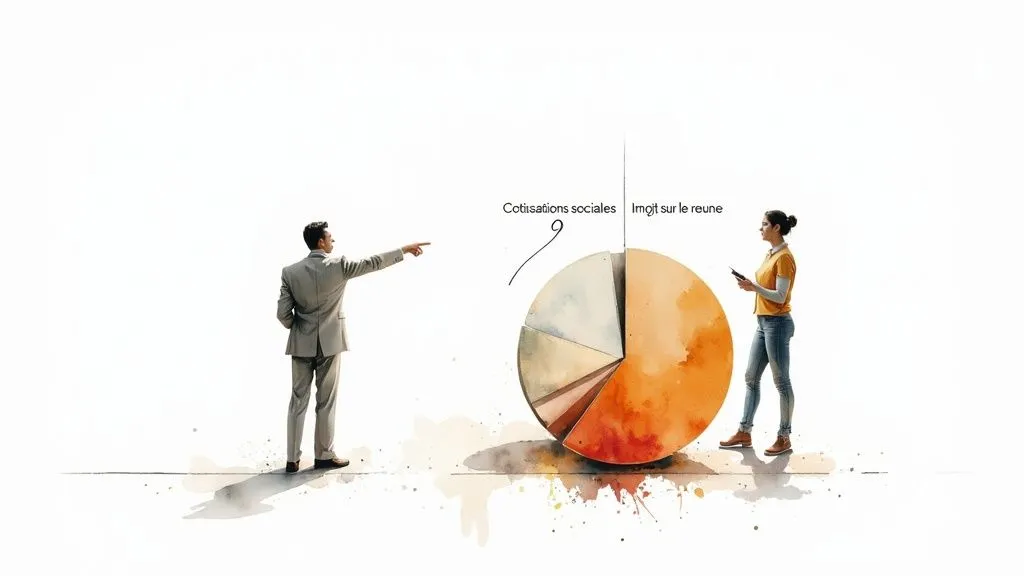
Let’s get straight to the point. Calculating your charges as a micro-entrepreneur is much easier than you might think. Forget the complex expense deductions of other business structures. The golden rule is simple: no revenue, no charges.
Your deductions revolve around two main pillars, complemented by a few specific contributions. Understanding this structure is the first step to managing your budget well and confidently anticipating your cash flow.
The two pillars of your charges
Most of what you pay falls into two categories:
- Social contributions: This is the core of your charges. They fund your social coverage (health, retirement, family allowances). The rate is directly linked to the nature of your activity: sales, services, or a professional (liberal) activity.
- Income tax: You have two options. The standard regime, where you benefit from a flat-rate allowance on your revenue before taxation. Or the withholding tax option (prélèvement libératoire), an attractive option that consists of paying a small additional percentage at the same time as your contributions.
Thanks to this simplicity, it becomes easy to set aside what you owe. A good habit to adopt is putting aside about 30% of every invoice collected into a dedicated account.
Other charges not to forget
Beyond these two pillars, other taxes, more modest but just as mandatory, come into play.
The Vocational Training Contribution (CFP), for example, is added to your contributions. Its rate is minimal (between 0.1% and 0.3% of your revenue), but it opens up rights to fund training and develop your skills.
There’s also the Corporate Property Tax (CFE). This is a local tax you’ll have to pay starting from your second year of activity, even if you work from home. Its amount depends on the municipality where your business is registered.
Expert tip: Good management is above all good anticipation. Knowing exactly what each charge amounts to protects you from bad surprises and helps you set prices that truly cover all your costs. To dig deeper into this topic, our guide to setting your sole trader rates is an excellent resource.
Keep an eye on how rates evolve. For example, social contribution rates are gradually increasing to fund supplementary retirement. This increase directly affects your net income, which generally sits between 60% and 70% of your revenue once all charges are paid.
Now that you have an overview, we’ll break down each element with concrete examples and the exact formulas to apply.
Calculating URSSAF social contributions: the basis of everything
Let’s dive straight into the core of the matter. The formula to know by heart is disarmingly simple: Collected revenue x Applicable contribution rate. This is the calculation you’ll do every month or every quarter, and it sets the rhythm of every sole trader’s financial life.
The system is deliberately simple and predictable. The rate that applies to you depends solely on the nature of your activity, full stop. No hidden fees, no convoluted calculations. What you collect dictates what you pay.
The advantage? You can anticipate your charges with remarkable precision. As soon as a client pays an invoice, you know exactly what percentage to set aside. That’s the secret to healthy cash flow management without the cold sweats.
Finding the right contribution rate for your activity
The first step, and the most important one to avoid mistakes, is identifying the rate that applies to you. These rates vary across three main activity categories and cover the essentials of your protection: health insurance, retirement (basic and supplementary) and family allowances.
Here are the overall rates currently in effect, applied to your revenue:
- Sale of goods (BIC): 12.3%
- Commercial and craft services (BIC): 21.2%
- Professional (liberal) activities and services (BNC): 21.1% for activities under the general regime and 21.2% for those affiliated with Cipav (architects, osteopaths, etc.).
It’s crucial to correctly classify your activity. A freelance graphic designer, for example, is engaged in a liberal activity (BNC). A plumber, on the other hand, provides craft services (BIC). If you juggle several types of activities, you’ll need to clearly separate the corresponding revenue figures when filing your return.
The extra line item: the vocational training contribution
On top of your contributions, a small additional contribution is systematically added. This is the Vocational Training Contribution (CFP).
Its amount is very small, but its impact is real. It’s what grants you rights to ongoing training, a valuable asset for building skills or even considering a career change.
The CFP rates are as follows:
- 0.1% for the purchase-resale of goods.
- 0.2% for liberal professions.
- 0.3% for craft services.
Take the concrete case of a web developer, who works as a liberal professional (BNC). Their base rate is 21.1%. Add the CFP of 0.2%. Their overall social contribution rate then rises to 21.3%. If they collect €3,500 in a month, the calculation is simple: €3,500 x 21.3% = €745.50 to pay to URSSAF.
Points to watch for a smooth declaration
To be sure your sole trader charges calculation is accurate, a few habits are worth adopting. These are often small details, but overlooking them can quickly lead to mistakes and complications with the administration.
The first and most fundamental point: you only declare collected revenue. An invoice issued on March 30 but paid by your client on April 5 should only be declared in April. Only money that has actually landed in your bank account during the period counts.
Next, a rule many beginners forget: you must declare your revenue even if it’s zero euros. Skipping it is considered a failure to declare and is penalized with a fine of around €50. A silly mistake that costs dearly!
Finally, if you have mixed activities, be rigorous. The URSSAF form is well designed, with separate boxes for each type of income. Take the time to correctly break down your amounts so the right rates apply. To go further on this point, our dedicated guide on calculating your social contributions will give you all the keys. This rigor is the best guarantee of smooth, compliant management.
Anticipating income tax and other taxes
Once social contributions are under control, it’s time to focus on taxation. This is the other essential pillar of your charges. Managing income tax and anticipating other taxes, such as the well-known CFE, is a key skill for ensuring the financial stability of your micro-business. This is often where unpleasant surprises pop up if you lack foresight.
Fortunately, the regime was designed to give you choices. For income tax, two paths are available, each with its own advantages. Your decision will directly impact your cash flow and the final amount you pay to the state.
The diagram below sums up the logic well: your collected revenue is the starting point, your type of activity determines the rates, and those rates define your charges. Simple, right?
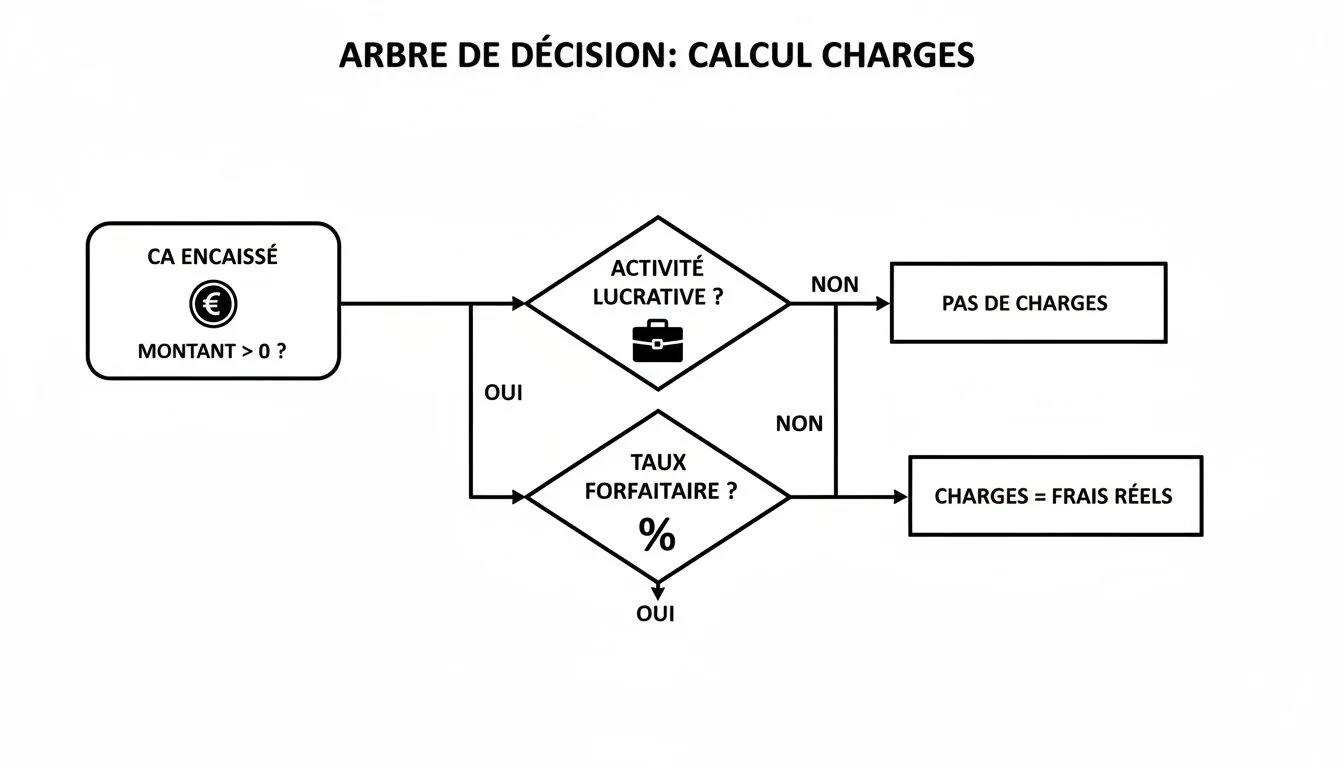
Visualizing this flow helps you understand that each sole trader charges calculation is ultimately just a series of fairly predictable steps.
Choosing your income tax method
You can choose between two systems for paying your income tax. It’s an important decision, though not a final one, that you generally make when starting your activity.
Option 1: The standard regime (micro-fiscal)
This is the default regime. The idea is simple: the tax administration assumes you have business expenses and applies a flat-rate allowance to your revenue to cover them. You cannot deduct anything beyond that.
This allowance varies by activity:
- 71% for purchase-resale activities and the provision of accommodation.
- 50% for commercial services (BIC).
- 34% for liberal professions and non-commercial services (BNC).
The amount remaining after this allowance is added to your household’s other income. The total is then subject to the progressive income tax scale.
Option 2: The final withholding payment (VFL)
This much more direct option lets you pay your tax at the same time as your social contributions, each month or quarter. A small percentage is simply added to your social deductions.
- +1% for purchase-resale.
- +1.7% for services (BIC).
- +2.2% for liberal professions (BNC).
So, which regime should you choose?
Take a consultant (BNC) with revenue of €40,000. With the VFL, they’ll pay €40,000 x 2.2% = €880 in tax for the year. If they’re single and not otherwise taxable, they’d pay €0 under the standard regime. The VFL is only worthwhile if your household is already taxable.
The VFL greatly simplifies management and smooths out the tax burden throughout the year. But be careful, it can make you pay more tax if, in reality, you’re not taxable. A simulation is always worthwhile.
The Corporate Property Tax (CFE): the tax to plan for
Often forgotten in the first year, the Corporate Property Tax (CFE) is a local tax that every sole trader must pay. You become liable starting from your second calendar year of activity. It’s the little year-end gift you’d rather avoid.
Its calculation is based on the rental value of the property you use for your activity. And yes, even if it’s just a corner of your home! No panic if you work from your living room: in that case, a minimal flat-rate base applies.
Amounts can vary significantly from one municipality to another, ranging from a hundred euros to more than €500 for the smallest bases. The tax notice usually arrives in November, for payment before December 15.
Fortunately, exemptions exist:
- The first calendar year of activity, you’re fully exempt. Phew!
- If your annual revenue is below €5,000, you’re also exempt.
- Certain craftspeople (and other professions) may also benefit from a permanent exemption.
The CFE is really the perfect example of a charge to anticipate. To avoid a cash flow gap at year-end, get in the habit of setting aside a small amount each month. Check with your municipality’s Business Tax Office (SIE) for an estimate of the amount and set aside between €20 and €40 per month. This simple habit will save you a lot of cold sweats and guarantee a calmer end of year.
VAT for sole traders: how does it work?

Value Added Tax (VAT) can seem intimidating at first, but how it works for sole traders is actually fairly easy to grasp. By default, when you’re starting out, you benefit from a very practical regime: the VAT exemption scheme (franchise en base de TVA).
What does that mean in practice? Simply that you don’t charge VAT to your clients. It’s a real plus for staying competitive, especially if you work with private individuals who can’t reclaim it anyway. In return, all your invoices must carry the legal mention: “VAT not applicable, art. 293 B of the French Tax Code”.
Keeping an eye on revenue thresholds
Be careful, this advantage isn’t permanent. It’s directly tied to revenue thresholds that you absolutely must monitor, especially if your business is taking off. Anticipating when you’ll cross them saves you a lot of hassle.
These thresholds vary depending on your type of activity and are regularly updated. There have indeed been recent adjustments, so it’s important to stay informed.
Currently, the base threshold is set at €91,900 for the sale of goods and €36,800 for services and liberal professions. An increased threshold, or tolerance threshold, is also in place: €101,000 for sales and €39,100 for services. If you exceed this second threshold, the change is immediate.
The switch to VAT is triggered automatically from the first day of the month in which you cross the tolerance threshold.
Moving to the actual VAT regime: a new stage
Crossing these thresholds isn’t a punishment — quite the opposite, it’s a sign your business is doing well! But it does bring new administrative habits.
Once you become liable for VAT, here are the three things to do:
- Request your intra-community VAT number. This is the very first thing to do. A simple contact with your Business Tax Office (SIE) is enough to activate it. It will be essential for your returns and invoices.
- Update your invoices. No more “VAT not applicable” mention. You must now clearly show the price excluding tax, the VAT rate (often 20%) and the price including all taxes.
- Start filing VAT returns. Depending on the tax regime (simplified or standard actual regime), you’ll need to periodically declare and pay the VAT collected, after deducting the VAT you paid on your purchases.
This change may seem like a burden, but it hides a significant advantage.
Reclaiming VAT, a powerful optimization lever
The major benefit of moving to VAT is the ability to reclaim VAT on your business expenses. And that completely changes the game in the sole trader charges calculation.
Take a concrete example. You buy a computer for your business at €1,200 including tax. On the invoice, you’ll see €200 of VAT. Once liable for VAT, you can deduct that €200 from the total VAT you owe the state. Your computer therefore only costs you €1,000 excluding tax.
This mechanism applies to a whole range of common expenses:
- Software subscriptions
- Purchase of raw materials
- Online advertising costs
- Certain travel expenses
To really master the subject and optimize your situation, I recommend reading our complete guide on managing VAT as a sole trader. It breaks down all the rules you need to know.
How to optimize your charges with the right support and a few smart habits
Paying your charges is an obligation. But optimizing them is a whole different story: it’s the strategy that will directly impact what’s left at the end of the month. Fortunately, it’s not just about pulling out a calculator. There are concrete support schemes and simple habits that can genuinely ease the pressure on your cash flow.
The most powerful lever, especially when starting out, is undoubtedly ACRE (business creation/takeover support). It’s the ultimate boost for launching your business with peace of mind.
ACRE: your best ally in the first year
Specifically, ACRE gives you a 50% reduction on your social contributions during your first four calendar quarters. If your normal contribution rate is 21.2%, it drops to 10.6% with this scheme. The effect on your finances is immediate and, frankly, quite impressive.
Take the example of a marketing consultant (liberal activity, BNC). Their overall rate goes from 24.6% to 12.3% during the first year. On revenue of €45,000, that represents a straightforward saving of €5,535. Enough to invest in equipment or build a small safety cushion.
To make it clearer, here’s a small simulation showing the direct impact of ACRE on your finances in the first year.
Simulation of ACRE’s impact on your charges (year 1)
This table compares the amount of social contributions with and without the ACRE scheme to illustrate the concrete savings you can achieve.
| Type of activity | Example annual revenue | Contributions without ACRE | Contributions with ACRE | Savings achieved |
|---|---|---|---|---|
| Services (BIC) | €25,000 | €5,300 (21.2%) | €2,650 (10.6%) | €2,650 |
| Sale of goods (BIC) | €40,000 | €4,920 (12.3%) | €2,460 (6.15%) | €2,460 |
| Liberal professions (BNC) | €35,000 | €7,420 (21.2%) | €3,710 (10.6%) | €3,710 |
The math is quickly done: the savings are significant, regardless of your field. ACRE is often granted automatically if you start your business while unemployed, but other profiles are also eligible. Take the time to check your eligibility. Missing out means literally leaving several thousand euros on the table.
Small habits that lead to big savings
Beyond this major scheme, a few good management habits can make a real difference. Running your business well isn’t just about being good at your craft — it’s also about being smart with admin tasks.
Monthly or quarterly declaration: a cash flow question
When you set up, you must choose between declaring your revenue monthly or quarterly. This isn’t a minor detail.
- Monthly declaration: Perfect if your income is regular. It smooths out payments and avoids the “big invoice” effect every three months. It’s easier to anticipate.
- Quarterly declaration: Maybe more practical if your activity is highly seasonal or if you simply prefer to consolidate your admin tasks.
Take stock and analyze your cash inflows. The goal is to match your collections and payments as closely as possible so you’re never caught off guard.
Build your “hidden” costs into your rates
This is the number one beginner mistake. As a sole trader, you can’t deduct your actual expenses: equipment purchases, software, travel, etc. The flat-rate allowance is supposed to cover all that, but let’s be honest, it doesn’t always do so.
The only solution? Anticipate. List all your business expenses (professional insurance, banking fees, subscriptions…) and subtly build them into your pricing. It’s the only way to protect your real margin and make sure what lands in your bank account truly reflects your work. Incidentally, if your activity relates to personal services, such as childcare, there are guides to help you calculate the costs and optimize the budget of a nanny, which can give you some ideas.
Frequently asked questions about micro-business charges
The sole trader status was designed to be simple, that’s true. But in practice, very concrete questions often come up. That’s perfectly normal! To help you get a clearer picture of your sole trader charges calculation, here are the answers to the questions that come up most often.
What happens if I forget to declare my revenue?
Take my word for it: forgetting to declare your revenue to URSSAF, even if it’s zero, is a very bad idea. The consequences aren’t theoretical. For each missing declaration, you get a flat fine of around €52. If you declare late, surcharges are added on top of what you already owe.
The worst-case scenario? If the omissions pile up, URSSAF can end up taxing you automatically. They then estimate your revenue themselves on a flat, increased basis, which can be much higher than your actual income. The final bill can be very, very steep.
A friendly tip: The best defense is prevention. Whether your declaration is monthly or quarterly, set a recurring reminder in your calendar. It’s a simple habit that will save you unnecessary stress and expense.
Can I deduct my expenses (computer, software, etc.) from my revenue?
The answer is a firm no. This is one of the golden rules, a pillar of the micro-entrepreneur regime. You can’t deduct any of your actual business expenses: not your equipment purchases, not your software subscriptions, not your travel costs. That’s precisely what makes the regime so simple to manage day to day.
To compensate for this, the tax administration applies a flat-rate allowance to your revenue before calculating your tax (for example, 34% for liberal activities).
In practice, this means you need to build all your costs (equipment, professional insurance, software, etc.) directly into your pricing. If you realize your actual costs far exceed this allowance, it might be time to ask whether the micro-entrepreneur status is still the best fit for you.
What if I have several different activities?
No problem, this is a very common scenario. You can absolutely combine consulting work with selling products, for example. The key is to clearly separate the revenue from each activity when filing your URSSAF return.
The online declaration form is actually designed for this, with separate lines for each type of income. URSSAF will then apply the correct contribution rate to each amount.
- €1,500 comes from your consulting work (liberal services, so BNC).
- €500 comes from selling handmade goods (sale of goods, so BIC).
You would simply enter €1,500 in the “Services” box and €500 in the “Sale of goods” box. Contributions are then calculated using the respective rates for each activity. Rigorous bookkeeping is therefore essential to avoid mixing everything up.
Is the final withholding tax payment always a good deal?
Not always, no. It’s a very appealing option because it greatly simplifies management: you pay your income tax at the same time as your social contributions, at a fixed rate. But it’s not necessarily the most cost-effective solution for everyone.
The final withholding payment becomes worthwhile if your household is already taxable, especially if you’re in a high tax bracket. Conversely, if you’re not taxable, you risk paying tax you wouldn’t have paid under the standard regime (after the flat-rate allowance).
Before ticking the box, run a quick simulation. Lay out the numbers and compare what you’d pay with the VFL against an estimate of your tax under the standard regime. This small check can save you several hundred euros over a year.
Our mission is to make sole trader charges calculation and all the paperwork that comes with it as simple as possible. With Bizyness, no more complex spreadsheets and manual reminders. Our tool handles your invoices, tracks your payments and prepares your tax returns for you. You can finally focus on your core business. Discover how Bizyness can transform your day-to-day as an entrepreneur.
