

 Français
The complete guide to the 'VAT not applicable art 293 B of the CGI' mention
Master the 'VAT not applicable art. 293 B of the CGI' mention. Discover the thresholds, invoicing rules and how to manage your e-commerce compliance stress-free.
Have you ever spotted this odd mention on an invoice: “VAT not applicable, art. 293 B of the CGI”? No need to panic. In practical terms, it means the business that invoiced you benefits from a specific tax regime, the VAT exemption scheme (franchise en base de TVA).
For that business, it changes everything: it doesn’t collect VAT on its sales, and therefore doesn’t have to remit it to the state. It’s an advantage that greatly simplifies administrative paperwork and can even let it offer lower prices to individual customers.
Understanding the VAT exemption scheme
Think of this regime as a kind of “pass” for small businesses and independents just starting out. Instead of juggling VAT returns, a process that can quickly become a headache, they’re simply exempted from it.
It’s a real relief for many business founders, whether they’re freelancers or sellers on marketplaces like Amazon or Etsy. The idea is to let them focus on what matters: finding customers and growing their business.
But be careful, this simplicity has a downside. The deal is that if you don’t collect VAT, you also can’t reclaim the VAT you pay on your own business purchases.
Let’s take a concrete example: you buy a new computer for your business, invoiced at €1,200 including tax. Within that price, there’s €200 of VAT. Normally, a VAT-registered business could deduct that €200. But under this regime, that’s not possible. VAT becomes a pure cost that eats into your margin.
So it’s a strategic choice to make: prioritize administrative simplicity or tax optimization? At launch, simplicity often wins out. But the bigger your business grows, the more that question deserves to be asked.
Mastering these rules of the game is essential for:
- Pricing intelligently: For a B2C customer base, not adding 20% VAT is a significant competitive advantage.
- Calculating your real profitability: You absolutely must factor the non-deductible VAT on your expenses (software, advertising, raw materials) into your margin calculations.
- Anticipating the future: This regime is conditioned on revenue thresholds. Exceeding them shifts you into the standard VAT regime, and it’s better to prepare for it!
This is exactly where a good management tool makes the difference. A solution like Bizyness helps you track your revenue in real time and can alert you when you’re approaching the thresholds. It’s the best way to avoid an unplanned exit from the scheme and the unpleasant surprises that come with it.
Are you eligible for the VAT exemption scheme?
If you’ve already seen the mention “VAT not applicable, art. 293 B of the CGI” on an invoice, know that it’s not a deliberate choice by the entrepreneur. It’s actually a direct consequence of their revenue. This scheme, called the VAT exemption scheme (franchise en base de TVA), was designed to simplify life for small structures by exempting them from collecting and declaring VAT. But be careful, access to it is tightly governed by revenue caps.
To find out if you’re eligible, the very first thing to do is clearly identify your main activity. The rules of the game, and especially the thresholds, aren’t the same for a product seller on Amazon and a freelance consultant offering services.
The revenue thresholds not to exceed
The tax authorities have defined two broad categories of activities, with distinct revenue (turnover) caps. These amounts are revised from time to time, so it’s crucial to always refer to the current year’s figures.
The principle is simple: to stay under the exemption scheme, your revenue from the previous year (N-1) must be below a certain threshold. Fortunately, there’s a bit of leeway, a “tolerance threshold” that lets you exceed it slightly without immediately switching over.
Here are the thresholds to know to stay under the exemption scheme in 2025:
-
Commercial and hospitality activities (sale of goods, etc.):
-
Base threshold: €91,900
-
Increased (tolerance) threshold: €101,000
-
Services and liberal professions (consultants, developers, etc.):
- Base threshold: €37,500
- Increased (tolerance) threshold: €41,250
In practical terms, how does it work? If your revenue for year N-1 is below the base threshold, everything’s fine, you stay under the exemption. If you exceed it but remain below the increased threshold, you can still benefit from the exemption that year. However, be prepared: you’ll have to charge VAT starting the following year.
This little diagram sums up the logic perfectly. Your revenue is the sole judge.
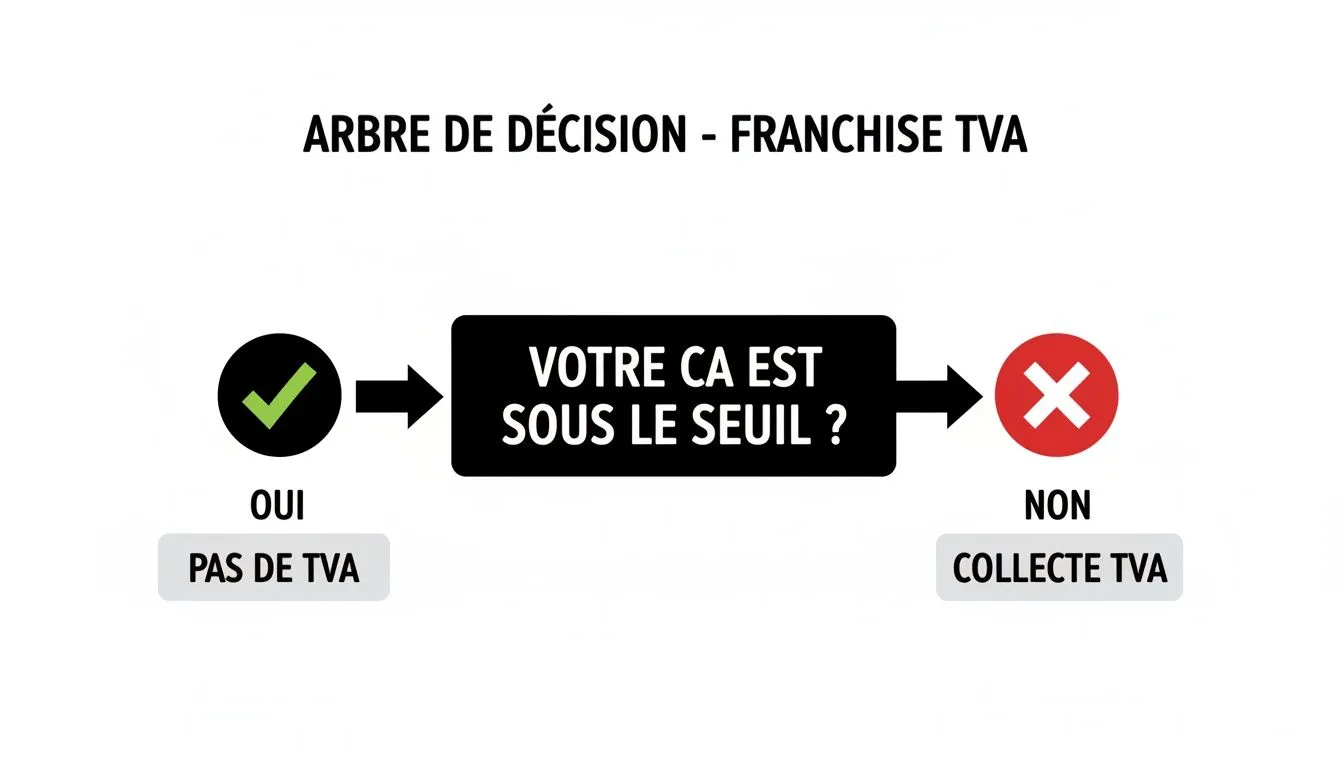
It’s clear: everything hinges on tracking these caps. That’s really the key to steering your business with peace of mind.
The special case of newly created businesses
What if you just launched partway through the year? The thresholds don’t apply as-is. They need to be recalculated pro rata temporis, meaning adjusted to your actual period of activity during that first year.
This rule makes sense. It prevents an entrepreneur launching in December from being able to invoice large sums in a single month and escape VAT the following year.
Let’s take a pro rata calculation example:
A web developer launches her business on July 1, 2024.
- Revenue collected: She invoices and collects €20,000 between July 1 and December 31.
- Pro rata adjustment: We’ll scale this figure up to what it would represent over a full year. She worked 184 days out of 366 (2024 is a leap year). The calculation is simple: €20,000 x (366 / 184) = €39,782.
- Conclusion: Her adjusted revenue of €39,782 exceeds the base threshold for services (€37,500). Thanks to the tolerance threshold, she’ll be able to stay under the exemption scheme in 2025, but she’ll have to start charging VAT from January 1, 2026.
The real impact on digital entrepreneurs
Imagine a freelancer who develops PrestaShop themes. In 2024, he generates €35,000 in revenue. He’s therefore well below the services threshold. All his invoices carry the famous mention “VAT not applicable, art. 293 B of the CGI”. The result? He can offer rates 20% lower than agencies subject to VAT. That’s a significant competitive advantage!
In France, this scheme is a genuine driver for the digital economy. It’s estimated that around 45% of micro-businesses in the sector (developers, SaaS, etc.) use it. But this advantage comes with a trade-off: it’s impossible to reclaim VAT paid on your own purchases, such as PayPal commission fees or subscriptions to software like Bizyness.
Tracking these thresholds is therefore central to your strategy. It’s not just an administrative constraint, it’s a lever that directly impacts your prices, your margins, and your market positioning. Tools like Bizyness are, incidentally, designed to automate this tracking and alert you as you approach the caps, helping you avoid having to switch to VAT in a rush. To dig deeper into the topic, feel free to read our article that explores in detail the status of a business exempt from VAT.
Applying the exemption day-to-day: invoicing and accounting
Knowing the thresholds of the VAT exemption scheme is one thing. But knowing how to juggle the rules on a daily basis is another. Your management, from invoicing to bookkeeping, changes completely under this regime. It’s therefore crucial to master the practical aspects to stay compliant and manage your business with peace of mind.
The first impact, the most visible one for your customers, shows up on your invoices. Every document you issue must carry a very specific legal mention.
The legal mention: an obligation never to forget
The rule is simple but inflexible: every invoice issued under the exemption scheme must clearly state the mention “VAT not applicable, art. 293 B of the CGI”. This isn’t a mere formality, it’s information with legal and tax value. It justifies why your prices are shown tax-exclusive and protects both you and your customer in the event of an audit.
Forgetting this mention can be costly. The tax authorities can fine you €15 per non-compliant invoice, with a cap set at a quarter of the total invoice amount. Worse still, if the omissions are frequent, it could be seen as an attempted fraud and lead to a much more troublesome requalification.
Take the example of a freelancer who uses Stripe to invoice clients. If he omits this famous mention on his 50 invoices for the year, an audit could cost him up to €750 in fines. Not to mention the time and energy lost sorting everything out.
The simplest way to avoid these headaches? Use a well-designed invoicing tool. Software like Bizyness, for example, automatically adds the correct mention to all your invoices as soon as you’ve set up your status. That’s peace of mind guaranteed.
Adapting your bookkeeping and tracking
One of the big advantages of the exemption scheme is, of course, administrative simplification. No more VAT returns (the famous CA3 or CA12 forms)! But be careful, this exemption doesn’t mean you can neglect your bookkeeping. Quite the opposite.
Your top priority becomes rigorous tracking of your revenue. You need to know at all times where you stand relative to the famous thresholds. At the start, a simple spreadsheet can do the job, but it quickly becomes a source of stress and potential errors as sales accumulate.
This is where automation becomes your best ally. By connecting a platform like Bizyness to your sales channels (whether Shopify, Amazon, or others), you centralize all your transactions. You then have a dashboard showing you in real time where you stand. Even better, you receive automatic alerts as you approach the thresholds, giving you time to anticipate leaving the scheme without panicking. To dig deeper into the topic, feel free to read our complete guide on the VAT exemption scheme.
The impact on your margins: a calculation not to take lightly
Here’s the most strategic point, one that’s often underestimated: under the exemption scheme, you can’t deduct VAT on your business expenses. Every euro of VAT you pay on your purchases — whether for raw materials, advertising, or software — becomes a flat cost that eats into your profitability.
To make this more concrete, here’s what it looks like in real life:
- Software subscriptions: Your favorite marketing tool, listed at €50 excluding tax, actually costs you €60 including tax.
- Advertising purchases: A €1,000 budget excluding tax on Google Ads means a cash outflow of €1,200 including tax.
- Stock and equipment: When you buy €5,000 excluding tax worth of goods, you actually pay €6,000 including tax.
This non-recoverable VAT must absolutely be factored into the calculation of your selling prices and margins. Ignoring it means risking selling at a loss without even realizing it. The best practice is simple: always think in tax-inclusive terms for your expenses. Then make sure your final selling price covers all these costs, including this VAT you’ll never recover.
International sales: how to manage VAT?
Crossing borders is often a key step in the life of an e-commerce business. It’s a sign of growth, but it also raises a whole host of questions about VAT, even though in France you’re perfectly comfortable with your “VAT not applicable, art. 293 B of the CGI” mention.
As soon as you start selling in Europe, new rules of the game apply. You’d better know them inside out to avoid unpleasant surprises and steer your growth with peace of mind.
The famous €10,000 European threshold and the OSS one-stop shop
Since July 1, 2021, the rules have been simplified for distance sales to individuals (B2C) within the European Union. A single threshold has been set at €10,000 excluding tax per year for all your sales in other EU countries.
In practical terms, what does that mean?
- As long as you’re under €10,000: No worries. You invoice your European customers exactly like your French customers. If you’re under the exemption scheme, your invoices remain VAT-free, with the usual mention.
- As soon as you exceed €10,000: Watch out, everything changes! From the sale that pushes you over this threshold, you must charge VAT. But not French VAT! You must apply the VAT rate of your customer’s country.
This is where the OSS (One-Stop Shop) comes into play. To spare you the nightmare of having to register for VAT in every country where you sell, the OSS lets you centralize everything. You declare and pay all the VAT collected across Europe through a single return, in France. Convenient!
The trap to avoid for businesses under the exemption scheme
Here’s a scenario that surprises many entrepreneurs. You can be entirely under the VAT exemption scheme in France (because your French revenue stays below the caps) and, at the same time, have to collect VAT abroad because your EU sales exceeded €10,000.
Imagine a jewelry maker selling on her WooCommerce store. She generates €25,000 in sales in France. On top of that, she sells for €8,000 in Germany and €3,000 in Belgium. Her total revenue is €36,000, well below the French threshold for the sale of goods. Yet her EU sales reach €11,000 (€8,000 + €3,000), exceeding the European threshold. She’ll therefore have to charge German VAT to her German customers and Belgian VAT to her Belgian customers.
This dual status is a common source of errors. You need to keep an eye on your national thresholds for the exemption scheme, and another on the European €10,000 threshold for the OSS. Also remember that selling internationally often means handling imports. If that’s your case, this complete guide to becoming an importer in France will give you all the keys on customs and import VAT.
How international revenue impacts your French thresholds
A question that comes up often: are my sales abroad taken into account when calculating my exemption thresholds in France? The answer is a resounding yes. It’s your global revenue that counts, whether generated in France or through exports.
Let’s take the example of a brand selling on Amazon FBA that generates €92,000 in revenue in 2024.
- €60,000 comes from sales in France.
- €32,000 comes from sales in other EU countries.
Her total revenue stays below the increased threshold for the sale of goods. She can therefore continue to apply the “VAT not applicable, art. 293 B of the CGI” mention for her French customers. However, for her €32,000 in European sales, she has well exceeded the €10,000 threshold and must collect VAT through the OSS one-stop shop.
Navigating between these different rules can quickly become a headache. Fortunately, tools like Bizyness are designed to handle this complexity. They can automate threshold tracking by country and prepare your OSS returns, letting you focus on your international growth with peace of mind.
Anticipating and managing your exit from the VAT exemption scheme
Is your business growing? That’s excellent news! But this growth often comes with a pivotal step: exiting the VAT exemption scheme. Far from being a punishment, this move to the standard VAT regime is actually a sign of very good health. You just need a bit of anticipation for the transition to happen smoothly.
Imagine you’re driving. The exemption scheme is first gear: ideal for starting off without stalling. But to really accelerate, you need to shift into second. And that means mastering a new tax mechanism.
In practical terms, there are two situations that push you out of the scheme. Each has its own rules and a precise timeline that’s essential to know to stay compliant.
Exceeding the thresholds: when the change is immediate
The first scenario is the most common. It’s triggered when your revenue blows past the authorized caps during the same year.
-
You blow past the increased cap: If, during the year, your revenue exceeds the tolerance threshold (for example, €101,000 for the sale of goods), the exit is immediate. You become liable for VAT from the first day of the month in which you exceeded it.
-
You hover near the cap for two years running: If your revenue sits between the base threshold and the tolerance threshold for two consecutive years, the exit is scheduled. You move to the standard regime on January 1 of the following year.
Timing is absolutely crucial. In the first case, if you exceed the threshold on October 15, you’ll need to reissue all invoices sent since October 1 to add VAT to them. It’s a delicate operation that can unsettle your customers if it’s not well explained.
Voluntarily opting for the standard VAT regime
Sometimes the best defense is offense. You can absolutely decide to switch to VAT before even reaching the thresholds. This strategy is particularly worthwhile in two situations.
-
You’re planning major investments: Purchasing equipment, significant stock, costly software… By switching to the standard regime, you’ll be able to reclaim the VAT paid on all these expenses. That’s a direct saving that can reach 20% on your investments.
-
Your customers are professionals (B2B): If you work mainly with other businesses, they reclaim VAT. For them, whether you charge VAT changes nothing about the final cost. It can even bolster your credibility and smooth your business dealings.
Exiting the exemption scheme is a natural step in the life of an e-commerce business. Well prepared, it’s nothing more than an administrative formality. Platforms like Bizyness are precisely designed to simplify this transition, by automating the update of your invoicing and preparing the ground for your future VAT returns.
The checklist for a successful transition
As soon as the exit from the scheme is confirmed, you need to act quickly and correctly. Here’s a roadmap to help you manage this transition without missing anything.
-
Notify your local tax office (SIE): This is the very first thing to do. You must inform the tax authorities of your change of regime. This step is essential to kick off the process.
-
Obtain an intra-community VAT number: The SIE will assign it to you. This number is mandatory and must appear on all your new invoices. It’s also the key to all your transactions within the European Union.
-
Update your invoicing: This is the most visible change. No more “VAT not applicable, art. 293 B of the CGI” mention. You must now apply the correct VAT rate to your products or services and show it clearly on your invoices.
-
Talk to your customers: For an individual (B2C) customer base, the impact on your prices is direct. Be transparent, explain the reasoning. Clear communication is the best way to keep their trust and avoid unpleasant surprises.
According to the DGFiP, about 15% of businesses under the exemption scheme exit the regime each year following a threshold breach. It’s a textbook case for fast-growing WooCommerce sellers. A tool like Bizyness then becomes a strategic ally for monitoring thresholds in real time and anticipating the switch, sparing you tax corrections that are often synonymous with fines. To go further, you can consult this article on the implications of art. 293 B of the CGI.
To guide you, here’s a summary table of the actions to take to manage this change smoothly.
Checklist for exiting the VAT exemption scheme
| Step | Action to take | Point of caution | How Bizyness helps |
|---|---|---|---|
| 1. Notification | Contact your SIE to report the change of tax regime. | Don’t delay! Do it as soon as you cross the threshold or make the decision. | Bizyness alerts you as you approach the thresholds so you can anticipate. |
| 2. VAT number | Request and obtain your intra-community VAT number. | This number is mandatory to invoice with VAT and for EU transactions. | You can save your VAT number in your settings so it displays automatically. |
| 3. Invoicing | Update your invoice templates: remove the mention, add the VAT rates. | Watch out for invoices issued during the month of the breach, which will need to be corrected. | Switching to the standard regime happens in one click. Bizyness applies the correct VAT rates to your new documents. |
| 4. Communication | Inform your customers (especially B2C) of the price increase tied to VAT. | Be pedagogical and transparent to avoid confusion and customer loss. | Integrate your new pricing terms into your communications and terms of sale. |
| 5. Bookkeeping | Set up tracking of VAT collected and deductible VAT. | Rigor is essential to prepare your future returns without error. | Bizyness automatically calculates VAT collected and helps you track deductible VAT to simplify your returns. |
By following these steps, exiting the VAT exemption scheme becomes far less intimidating. It turns into what it should be: a simple confirmation of your success.
Manage your VAT with complete peace of mind with Bizyness
The mention “VAT not applicable, art. 293 B of the CGI” is a fantastic springboard for getting started, that’s true. But let’s be honest, it’s a mechanism that demands constant monitoring so it doesn’t turn into a real headache. Threshold tracking, in particular, can quickly become a source of stress that pulls you away from your real goal: growing your business.
That’s exactly why tools like Bizyness exist. We designed our platform specifically for e-commerce entrepreneurs, to automate this whole tax compliance side. The idea is simple: let you focus on your sales, while the system handles invoicing and meticulous tracking of the exemption scheme’s caps.
Simplify your life (and your tax management)
With Bizyness, administrative obligations that used to take you hours become a smooth, well-managed process. The platform goes even further by handling the complexity of international sales, thanks to the integration of OSS and IOSS rules. Your growth abroad is thus secured from day one.
Of course, for precise tracking, you can always cobble together a financial dashboard in Excel. It’s a solution that has proven itself. But the automation offered by Bizyness frees you from this manual task, often tedious and error-prone.
Think of Bizyness less as a simple piece of software and more as a co-pilot for your business. It secures your journey by handling repetitive tasks and gives you a clear, real-time view of your financial and tax situation.
By centralizing all your data, Bizyness gives you back control and, above all, time. Time to devote to what really matters: growing your business. If you want to see how the platform can simplify much more than VAT, take a look at our accounting features designed for e-commerce sellers.
To sum up, the VAT exemption scheme is a real opportunity, but on one condition: being well equipped. With the right partner, you can navigate the complexities of VAT with peace of mind and fully focus on your success.
Frequently asked questions about article 293 B of the CGI
The VAT exemption scheme is a great boost to get started, but it often brings its share of very concrete questions. Let’s untangle together the points that can cause confusion so you can manage your business with peace of mind.
Can you mix invoices with and without VAT?
The answer is simple: no, it’s all or nothing. The exemption scheme applies to your entire business. You can’t choose to charge VAT to some customers and not others. If you benefit from this scheme, all your invoices must be issued without VAT and include the famous legal mention.
The only small nuance concerns sales to individuals within the EU. If you exceed the overall €10,000 threshold for distance sales in Europe, you’ll have to charge your customer’s country’s VAT (via the OSS one-stop shop). But this changes nothing for your sales in France, which will remain under the exemption scheme.
I forgot the mention on an invoice, what should I do?
Don’t panic, it happens! But you need to act quickly. Forgetting the “VAT not applicable, art. 293 B of the CGI” mention can cost you a fine of €15 per non-compliant invoice. The best thing to do is immediately send a corrected invoice to your customer. This is, incidentally, one of the big advantages of a good invoicing tool: it automates adding this mention and spares you this kind of stress.
How does it work if I have a mixed activity?
Do you sell products and also offer services? In that case, there are two caps to watch closely.
- Your total revenue (sales + services) must not exceed the higher threshold, that of goods sales: €91,900.
- And, within that total, the share from your services must not exceed their own cap: €37,500.
You therefore need to keep an eye on both indicators to stay compliant.
I exceeded the thresholds… can I go back to the exemption scheme later?
Absolutely. A business’s life has its ups and downs. If, after switching to the standard VAT regime, your revenue drops back below the exemption thresholds for a full calendar year, you’re entirely entitled to request to benefit from it again. This change will take effect on January 1 of the following year.
So that managing your invoices and VAT is never a headache again, discover how Bizyness can automate all of this for you. Whether you’re under the exemption scheme or the standard regime, the tool adapts to guarantee your compliance. Take a look at https://www.bizyness.fr to learn more.
