

 Français
VAT not applicable: the guide to fully compliant invoices
Master the VAT not applicable mention (art. 293 B of the French Tax Code). Our guide explains when and how to use it for 100% compliant invoices.
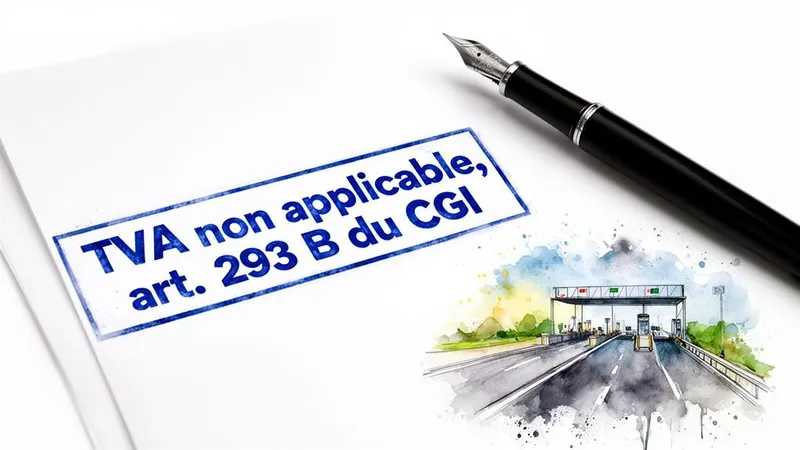
You’ve probably already come across this short phrase at the bottom of an invoice: “VAT not applicable.” Far from being a simple administrative detail, this mention is the key to a very specific tax regime, designed to simplify life for small businesses and sole traders. In practice, it means you fall under the VAT exemption scheme (franchise en base), and are therefore allowed not to charge this tax to your clients.
Decoding the vat exemption scheme
Think of VAT management as a sometimes complex administrative journey. The VAT exemption scheme is a bit like a fast-track pass: it exempts you from the steps of collecting, declaring, and remitting VAT. It isn’t some obscure tax loophole, but a legal mechanism designed to lighten your day-to-day accounting workload.
The most obvious advantage? More competitive prices. If your clientele is mostly made up of individuals, not having to add 20% VAT gives you a significant edge over competitors who are subject to it. Your final prices are simply more attractive.
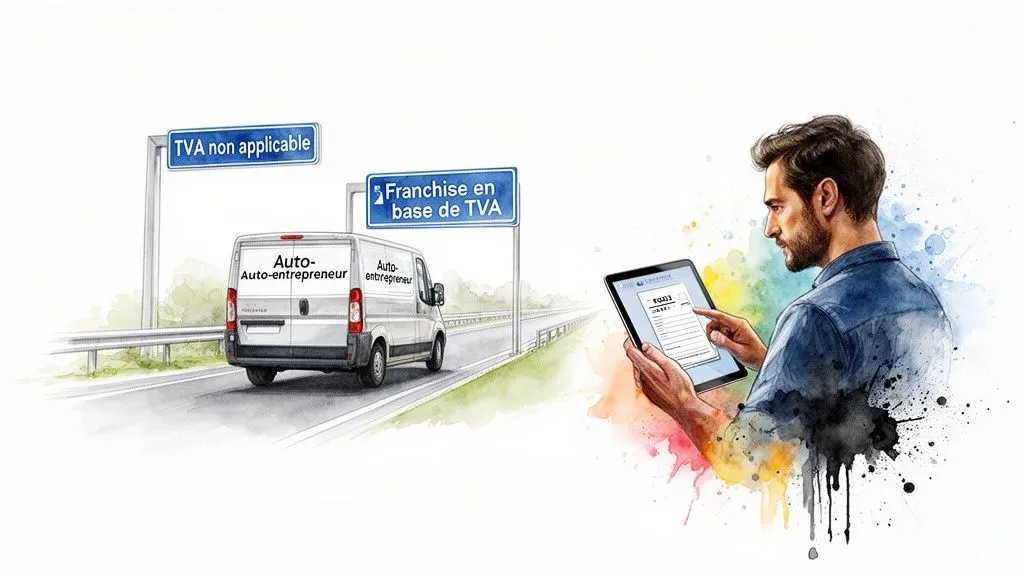
The other major benefit is time saved. No more headaches with VAT returns, often a source of stress and potential errors when you’re running your business solo. You free up precious time to focus on your core business.
The thresholds to keep an eye on
Of course, this simplified regime comes with conditions. To benefit from it, your annual revenue must stay below certain caps. In France, a sole trader can invoice without VAT as long as they don’t exceed the following thresholds:
- €37,500 for services.
- €85,000 for commercial activities (sale of goods).
To learn more about how these thresholds evolve, you can check the information provided by Indy.fr.
Staying vigilant about these thresholds is essential. The slightest overshoot moves you into the standard VAT regime, with all the obligations that come with it.
This is where a good invoicing tool becomes more than useful: it becomes a real ally. A tool like Bizyness acts as a smart dashboard. It ensures every invoice issued contains the correct mention and, more importantly, alerts you as you approach the limits you shouldn’t cross. That means you can run your business with total peace of mind.
You often hear that the VAT exemption scheme is reserved for micro-entrepreneurs. That’s a rather persistent misconception, but the reality is much more flexible. This tax regime is actually available to many businesses, regardless of their legal form.
Whether you run a SASU, an EURL, or operate as a sole proprietorship, the door isn’t closed. The deciding factor isn’t your legal status, but your annual revenue. As long as you stay under certain caps, you can absolutely benefit from it.
Revenue thresholds not to exceed
The number-one criterion for using the famous “VAT not applicable” mention is therefore the amount of your net revenue (excluding tax) from the previous year (year N-1). These caps aren’t the same for everyone; they depend directly on the nature of your activity.
There are two broad categories:
- Commercial and accommodation activities: This includes the sale of goods, takeaway food service, or the provision of lodging.
- Services and liberal professions: This covers craftspeople, consultants, graphic designers, developers, and all service-based trades.
And what if you have a mixed activity? Imagine a plumber who also sells boilers. In that case, a double rule applies: their overall revenue must not exceed the cap for commercial activities, and the “services” portion must also stay under its own threshold. This is an important point to watch. To dig deeper into the topic, feel free to read our full article on how to be exempt from VAT.
To make things clearer, here’s a small table summarizing the thresholds to keep in mind.
Vat exemption scheme caps by activity
This table gives you the net revenue figures not to exceed in order to benefit from the exemption scheme.
| Activity category | Exemption threshold (net revenue, year N-1) | Increased tolerance threshold (net revenue, year N-1) |
|---|---|---|
| Sale of goods and accommodation | €91,900 | €101,000 |
| Services | €36,800 | €39,100 |
Noticed the “tolerance threshold” column? It’s a kind of safety net. If, in a given year, your revenue exceeds the base threshold but stays below this increased threshold, you can keep the benefit of the exemption. Be careful though: if you exceed the increased threshold, or if you stay in this tolerance zone for two consecutive years, you move into the VAT regime. And this takes effect from the first day of the month in which the overshoot occurs.
Activities that cannot benefit from it
Some activities are automatically excluded from this scheme, even if their revenue is very low. This is required by law.
The main ones concerned are:
- Real estate transactions, which are compulsorily subject to VAT.
- Activities that fall under the simplified agricultural regime.
- Businesses that have voluntarily chosen to pay VAT (known as opting for VAT).
These cases are fairly specific, but it’s always good to keep them in mind to avoid an unpleasant surprise from the tax authorities. For the vast majority of freelancers, craftspeople, and small retailers, the only real indicator to watch remains revenue.
The exact wording to put on your invoices
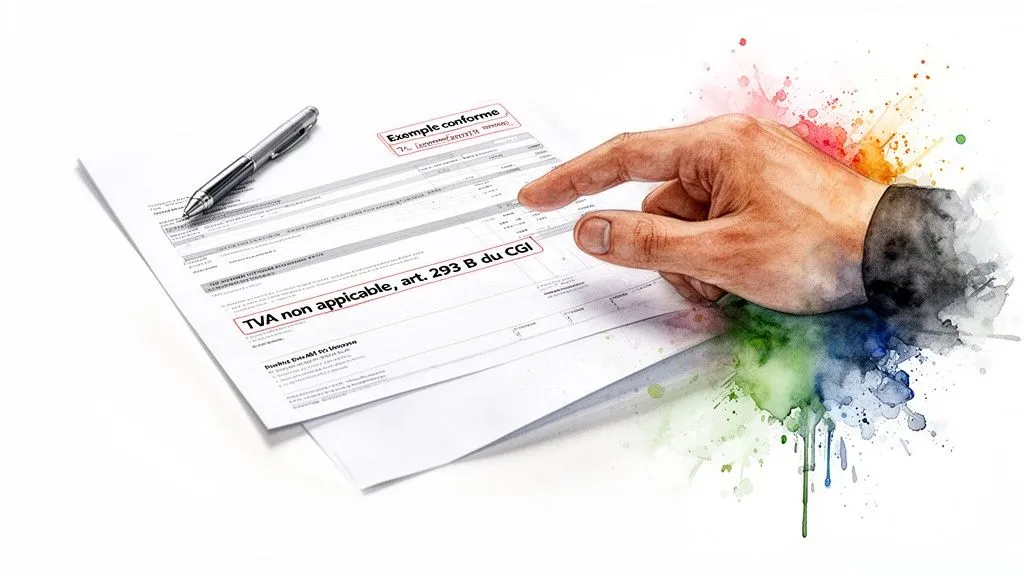
When it comes to invoicing, precision is king. Every word matters. To correctly apply the VAT exemption scheme, there’s no room for improvisation: only one single wording is recognized by the tax authorities. The slightest inaccuracy could be seen as an error and expose you to complications.
The legal mention you must include on all your invoices is as follows:
“VAT not applicable, art. 293 B of the French Tax Code (CGI)”
This phrase isn’t a mere suggestion, it’s a formal obligation. It tells your client, and above all the tax authorities, in no uncertain terms, that your invoicing is exempt of tax under a very specific article of the French Tax Code (CGI).
Why is this wording so important?
Let’s break down this phrase a bit to grasp its full value. “VAT not applicable” is a clear statement that leaves no room for doubt. But it’s the addition of “art. 293 B of the CGI” that makes all the difference.
This legal reference is crucial: it grounds your situation in a well-defined legal framework. You aren’t skipping VAT out of oversight or ignorance; you’re applying a legitimate tax regime that authorizes you to do so. Omitting this reference is a bit like presenting a bus ticket without a validity date. The main information is there, but proof of its legitimacy is missing. This is the justification that will protect you in the event of an audit.
Here’s a concrete example of an invoice where the mention is correctly placed, usually at the bottom of the document, for optimal visibility.
As you can see in this example, the VAT not applicable mention is clearly and legibly integrated, which ensures the document is fully compliant.
Mistakes you should absolutely avoid
In the heat of the moment, you might be tempted to use shortcuts or wordings that seem equivalent. This is a classic mistake that can unfortunately draw the attention of the tax authorities.
Here’s a short list of wordings to avoid on your invoices:
- “VAT exempt”: This term is legally incorrect. The VAT exemption scheme (franchise en base) is not the same as a VAT exemption (exonération) — they are two distinct tax regimes.
- “No VAT” or “Without VAT”: This is too casual and imprecise. These mentions have no legal value because they lack the reference to the relevant article of law.
- Forgetting the mention entirely: This is obviously the worst mistake. An invoice issued without this mention, while you’re under the exemption scheme, can be reclassified by the tax authorities, who could then claim the VAT from you.
To go further, feel free to check out our full guide on invoicing as a micro-entreprise without VAT, it’s a goldmine of information. And to get a full picture of all your obligations, beyond VAT, it’s always a good idea to refer to a comprehensive guide on all the legal mentions your business must comply with.
What to do when you exceed the vat thresholds?
Exceeding the VAT exemption thresholds isn’t a punishment, quite the opposite! It’s often a sign that your business is doing well and growing. Think of it as moving up a league: you’re leaving a category with simplified rules to enter the big leagues. It’s a step that can feel a little intimidating, but it’s perfectly manageable if you prepare for it properly.
The switch takes effect on the first day of the month in which you crossed the line. This is a crucial point to understand. For example, if your revenue exceeds the increased threshold on October 15, all invoices you issue from October 1 onward must include VAT. The famous “VAT not applicable” mention must therefore disappear instantly from all your documents.
The first administrative steps
Your first reflex? Contact your local Business Tax Office (Service des Impôts des Entreprises, SIE). You need to inform them of this change as quickly as possible. They will then assign you an intra-community VAT number, essential for declaring and remitting the VAT you’ll now be collecting from your clients.
This transition to the standard VAT regime brings new obligations with it. Your bookkeeping will need to become more rigorous, and you’ll need to file regular VAT returns, whether monthly or quarterly. This is often the perfect time to equip yourself with a good invoicing tool that will save you precious time.
Anticipation is really the key word here. Keeping an eye on your revenue lets you prepare the ground: you can adjust your prices gradually and get your cash flow ready, without having to impose a sudden increase on your clients overnight.
A tool like Bizyness is precisely designed to support your growth. As soon as you cross the thresholds, all you need to do is update your tax status in the settings. The software takes care of the rest: it updates your invoice templates to include the correct VAT rates, automatically calculates the amounts, and does the heavy lifting for your VAT returns. Real peace of mind!
To fully understand all the ins and outs, our complete guide on exceeding the VAT threshold as a sole trader is a read I highly recommend.
Preparing your pricing and communication
For your clients, the most visible change will of course be the increase in your tax-inclusive prices. Clear, honest communication is essential here. Take the time to explain that this change is linked to your business’s growth, not a sudden urge to increase your margins. Transparency is always appreciated and helps maintain a relationship of trust.
Pros and cons of the vat exemption scheme
When starting out, opting for the VAT exemption scheme and its famous “VAT not applicable” mention often seems like a no-brainer. Less paperwork, more attractive prices… what more could you ask for? But be careful, it isn’t always the best choice in the long run. It’s a real strategic decision, one that deserves serious weighing of the pros and cons.
The first advantage, the one that jumps out immediately, is simplicity. No VAT to manage means no complex returns to file, lighter bookkeeping, and ultimately, precious time saved.
And that time is really not a minor detail. VAT is the lifeblood of state finances, with €210.7 billion in expected revenue in 2024. For micro-entrepreneurs, who made up more than 60% of the 2.8 million self-employed workers in 2023, sparing themselves this administrative gymnastics is a real relief. It’s estimated to save them an average of 20 hours per year. Precious hours to devote to what they do best: their trade. If the topic interests you, you’ll find a full analysis of the role of VAT on clubpatrimoine.com.
The other major advantage is the pricing edge, especially if you’re targeting individual clients. By not charging 20% VAT, your prices are effectively lower than those of competitors who are subject to it. A strong selling point!
The flip side: non-recoverable vat
But this lovely simplicity comes at a cost, and it can quickly add up. The main drawback of the exemption scheme is that you cannot recover VAT on your own business expenses. Absolutely everything you buy — equipment, software, raw materials, services — you pay at the tax-inclusive price.
For a marketing consultant with very few expenses, the impact is minimal. Simplicity wins hands down. On the other hand, for a craftsperson who constantly buys tools and materials, or an e-commerce seller who has to build up substantial stock, the calculation is quite different. Non-recovered VAT directly eats into their margin and profitability.
Choosing the exemption scheme is a bit like opting for a small city car. It’s perfect and economical for short trips around town (activities with low expenses). But if your plan is to cross the country (heavy investments), a more powerful model, even if it’s more complex to handle (the standard VAT regime), will ultimately be far more suitable and profitable.
The infographic below gives you a clear view of the decision tree to follow as you approach the VAT thresholds.
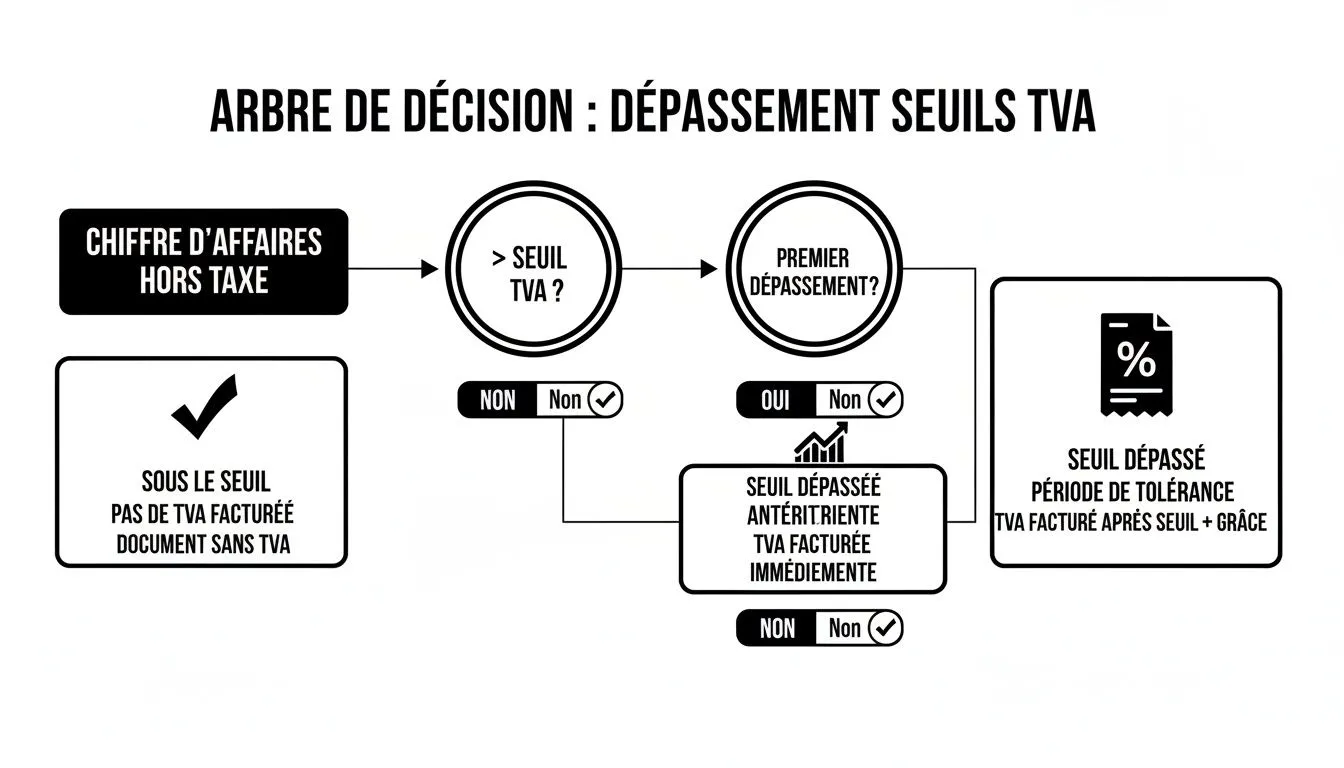
This tree makes it clear: exceeding the thresholds isn’t a failure, but a natural stage in your business’s growth. It’s simply the signal that it’s time to move to charging VAT.
So, for or against?
The decision depends entirely on your business model and your ambitions. To help you see things more clearly, nothing beats a good old side-by-side comparison.
Comparison table: vat exemption scheme, for or against?
Here’s a summary of the key points to help you position your business and make the right decision for your growth.
| Advantages (Why adopt it) | Drawbacks (When to avoid it) |
|---|---|
| Administrative simplicity: No VAT return to manage. | Non-deductible VAT: Impossible to recover VAT on purchases. |
| Competitive prices: Your rates are lower for individual clients. | Penalizing for investments: Higher cost for equipment and stock. |
| Lighter cash flow management: No VAT to collect and then remit to the state. | Less “professional” image: Some B2B clients may be reluctant. |
At the end of the day, the best approach is to run your numbers. Analyze this table against your revenue and expense forecasts. That’s the only way to know whether the “VAT not applicable” mention will be a real asset or a hindrance to your growth.
Frequently asked questions about invoicing without vat
Invoicing without VAT often raises a lot of very concrete questions. Even when you think you’ve understood the general principle, you quickly run into a specific case that leaves you puzzled. No need to panic, this FAQ is here for exactly that: turning theory into practice and giving you clear answers.
Let’s go through the most common situations together so you’re ready for anything in your day-to-day life as an entrepreneur.
Can you choose to charge vat even below the thresholds?
Yes, absolutely! It’s an option few entrepreneurs know about, but it can prove very worthwhile. Even if your revenue allows you to benefit from the exemption scheme, you have every right to opt for the standard VAT regime.
This is a purely strategic decision. It becomes really interesting if you plan to invest or make large purchases for your business: equipment, raw materials, software, stock… By choosing to charge VAT, you’ll then be able to deduct the VAT you pay on all these expenses, which can represent significant savings.
To take the plunge, you simply need to apply through your local Business Tax Office (SIE). Do keep in mind, however, that this choice commits you for a minimum of two years, so it’s a decision worth thinking through carefully.
What happens if I forget the mention on an invoice?
Forgetting the famous “VAT not applicable, art. 293 B of the CGI” mention isn’t just a minor administrative slip, it can prove costly. If you’re audited, the tax authorities may deem your invoice non-compliant.
The biggest risk? That the tax authorities decide you should have collected VAT. They could then claim the amount of that VAT from you, even if you never actually collected it from your client. It’s also a real headache for the bookkeeping of your business clients, who need impeccable documents.
To rest easy, the best approach is to automate. A good invoicing tool like Bizyness is configured to automatically insert all the mandatory legal mentions. One less thing to worry about.
How do you invoice a client based abroad?
When you’re under the VAT exemption scheme, the basic rule is simple: you never charge VAT, whether your client is around the corner or on the other side of the world.
The VAT not applicable mention therefore remains essential on your invoices. There’s just one small nuance to know if you sell services to business clients based in another European Union country.
In this specific case, you must:
- Request your client’s intra-community VAT number.
- Include it on your invoice.
- Add a specific mention: “VAT exemption – Article 283-2 of the CGI.”
Do you need to request an intra-community vat number?
Even under the exemption scheme, the answer is sometimes yes. You are required to request an intra-community VAT number as soon as you do business with companies located in other EU countries.
This mainly concerns you in two situations:
- You purchase services from a European supplier.
- You sell services to a European business client.
This number is essential for filing certain returns, such as the Declaration of Exchange of Services (DES). The application is free and is made simply through your local business tax office (SIE). One piece of advice: plan ahead and apply as soon as you’re considering working with European partners. For more general information on various business or service-related matters, you might also check their FAQ page to find answers to other questions.
Ready to say goodbye to invoicing stress and make sure every document is fully compliant? Bizyness is the tool designed for sole traders and small businesses who want simple, reliable management. Generate flawless invoices in just a few clicks on bizyness.fr.
