

 Français
VAT reverse charge article 283 2: the complete guide for e-commerce
Master the VAT reverse charge under article 283 2. Our e-commerce guide covers obligations, invoicing and returns to help you stay compliant.

Behind the somewhat technical term VAT reverse charge, set out in article 283 2 of the French Tax Code (CGI), lies a tax mechanism that every e-commerce seller buying from abroad needs to master. Far from being a simple administrative formality, it’s a system that radically simplifies your international transactions.
The principle is simple: responsibility for VAT is reversed. Normally, you pay VAT to your supplier, who then remits it to the State. With the reverse charge, it’s you, the buyer, who takes charge of declaring and paying this VAT directly to the French tax authorities.
Understanding the role of the VAT reverse charge
Let’s get concrete. Imagine switching hats for a moment. Instead of paying VAT to your supplier based in Ireland or China, you’re the one who calculates it and includes it in your own French VAT return. For most businesses, this operation is entirely cash-flow neutral, but it’s absolutely essential for staying compliant.
This system was set up to streamline and secure international trade — a real boon for e-commerce sellers who deal daily with suppliers, service providers and platforms from around the world.
The reverse charge is simply a role swap. The customer becomes responsible for collecting and paying VAT instead of the supplier. This is referred to as “shifting the liability.”
In practice, this mechanism applies to very common situations in an e-commerce seller’s day-to-day life:
- Buying online services: Your Google Ads or Meta advertising campaigns, your subscriptions to SaaS tools (like Shopify, Klaviyo or a design tool) all fall squarely into this category.
- Purchasing goods within the EU: For example, when you source stock from a wholesaler in Germany, Spain or Italy.
- Importing goods from non-EU countries: Since 2022, the reverse charge has become the default regime for import VAT — a real simplification of customs formalities.
Why does this mechanism exist?
This isn’t an invention designed to complicate things — quite the opposite. The reverse charge was created to combat massive fraud, notably the infamous “VAT carousel fraud” schemes that cost European states colossal sums in the early 2000s. A 2008 European Commission report had already sounded the alarm.
The real turning point for imports came on 1 January 2022. Since that date, the system has been rolled out across the board. All VAT-registered businesses now automatically benefit from the reverse charge on their goods imports, which today accounts for roughly 15% of all VAT returns.
The practical impact for your e-commerce business
Understanding the reverse charge properly turns a legal obligation into a smart management tool. The most obvious benefit is for your cash flow. Gone are the days when you had to advance VAT to your foreign suppliers and then wait (sometimes a long time) for the State to refund it.
Everything is handled through a simple set of entries on your VAT return (the well-known CA3 form). On one side, you declare the VAT you would have owed as collected VAT. On the other, you immediately deduct it as deductible VAT. The result is a wash: zero impact on your cash flow. To make sure everything is spotless, it’s essential to know how to properly issue reverse-charge invoices. This practical guide will walk you through it step by step.
Key situations where the VAT reverse charge applies to your e-commerce business
To make things clearer, here’s a summary table of the most common scenarios for an e-commerce seller.
| Your situation as an e-commerce seller | Type of transaction | Reverse charge applies | Concrete example |
|---|---|---|---|
| You buy a service from a foreign company | B2B service purchase | Mandatory | Your monthly subscription to a US-based SaaS solution like Shopify, or your ad budget on Meta (Ireland). |
| You buy goods from an EU supplier | Intra-EU B2B acquisition | Mandatory | You order a batch of stock from a wholesaler based in Germany to resell on your site. |
| You import goods from a non-EU country | B2B import | Automatic and mandatory | You bring in goods from a manufacturer in China to stock your online shop. |
| You buy on a marketplace a product sold by a foreign seller | Marketplace purchase | Depends on the marketplace | You buy equipment via Amazon Business from an Italian seller. The reverse charge applies. |
This table makes it clear that the reverse charge is not optional — it’s a baseline rule as soon as your business purchases cross borders. Mastering it is therefore essential to running a sound, compliant business.
Article 283 II of the CGI in practice: how does it work?
At first glance, the VAT reverse charge mechanism under article 283 II of the CGI can seem a bit daunting. But in reality, the principle is quite simple: it just swaps the roles. It’s no longer the seller who collects VAT — it’s you, the buyer, who bears that responsibility directly.
Let’s take a classic example. A French supplier sells you a product for €1,000 excl. VAT. They add 20% VAT, i.e. €200, and you pay them €1,200 incl. VAT. It’s then up to them to remit that €200 to the State.
With the reverse charge, everything changes. Your supplier, say based in Germany, sends you an invoice for €1,000, but this time with no VAT. That’s where you come in. Your job is to calculate the French VAT that would normally apply (€200) and declare it yourself.
A wash for your cash flow
The real trick is that this system is entirely neutral for your cash flow, as long as your right to deduct is complete. Everything happens on your VAT return (the famous CA3 form) through a simple set of accounting entries.
In practice, here’s the two-step process:
- You declare the VAT “due”: You enter the €200 in the collected VAT box, as if you had just invoiced it to a customer.
- You deduct that same VAT: At the same time, you report the exact same €200 amount in the deductible VAT box.
The result? +€200 on one side, -€200 on the other. The net impact is zero. You have nothing to pay out, unlike a standard purchase where you would have had to advance the VAT before hoping to recover it later.
The diagram below sums up this flow perfectly, from the foreign supplier to the French State, passing through your business.
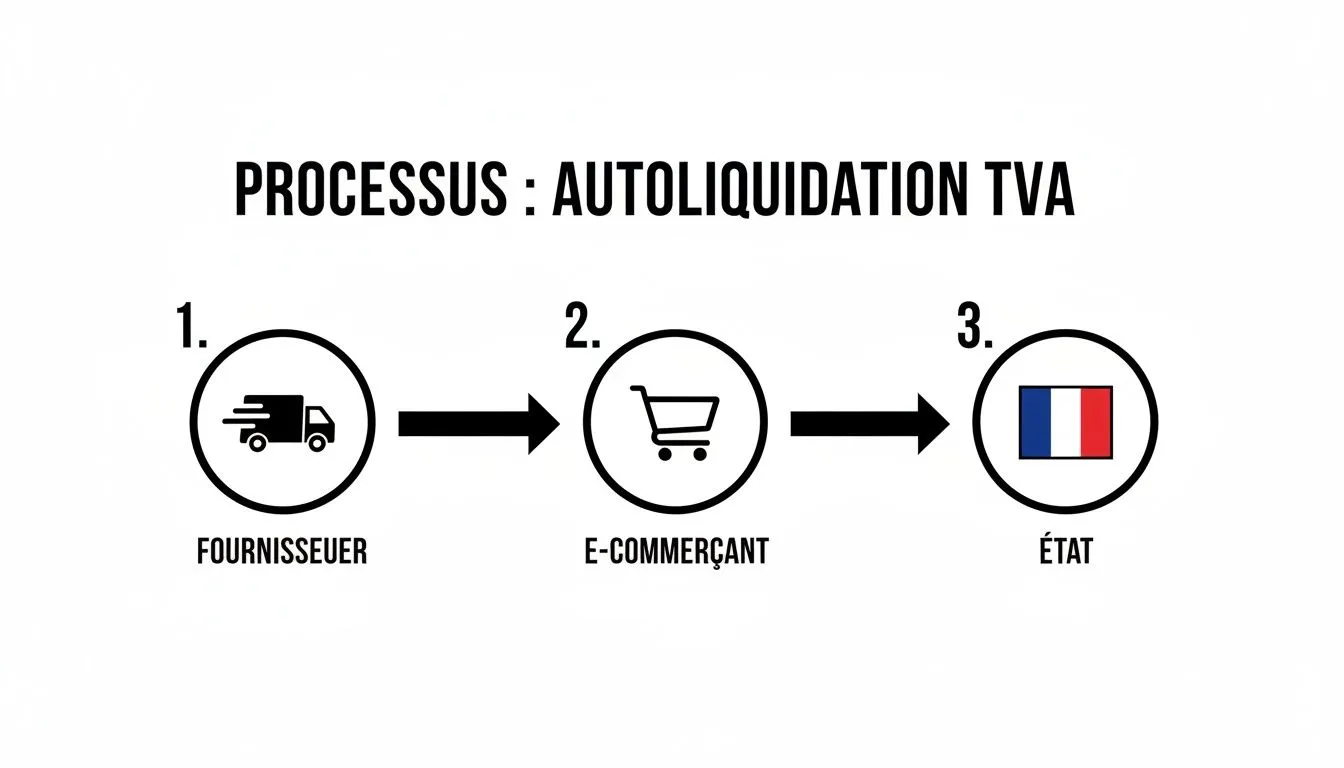
This visual makes clear that VAT money no longer flows through the supplier. Everything is handled internally by the e-commerce seller at the time of filing.
Rigor is your best ally
Even though the principle is simple, the mechanism demands absolute administrative rigor. Failing to declare an operation under the reverse charge is a common mistake that can cost you dearly: a 5% penalty on the amount of VAT omitted, even though the impact would have been cash-flow neutral.
You also need to draw a clear line. The VAT reverse charge under article 283 II applies to your B2B purchases (between businesses). Be careful not to confuse it with your B2C sales (to consumers) within the EU, which instead fall under the OSS (One-Stop Shop) or IOSS (Import One-Stop Shop) single-window schemes.
Think of the reverse charge as an authorized accounting shell game: you’re both the one who owes the tax and the one who reclaims it. You transfer money from the “collected VAT” pocket to the “deductible VAT” pocket, all under the watchful eye of the tax authorities.
This simplification is one of the pillars of the French tax system. To give you an idea, in 2023 the DGFiP (French tax authority) recorded 4.2 million businesses declaring a total of €202 billion in VAT. By automating the declaration, the reverse charge greatly eases the burden on businesses trading internationally. You can also check out the DGFiP’s VAT statistics and analyses to learn more.
Knowing how to identify the purchases concerned
As an e-commerce seller, the scope is broad. It’s therefore essential to correctly identify each flow so you apply the right rule.
- Intra-EU acquisitions of goods: You order your stock in Germany. The supplier invoices you excl. VAT. It’s up to you to reverse-charge French VAT on your return.
- B2B services: You pay your Shopify subscription (based in Ireland) or run a Google Ads campaign. These services are invoiced to you excl. VAT, and you must reverse-charge the VAT.
- Imports of goods from outside the EU: You import products from China. The good news is that, since 2022, the import VAT reverse charge has become automatic and mandatory on the CA3 return, which greatly simplifies customs formalities.
Each scenario follows the same principle, but may require filling in different lines on your return. Well-kept accounting is therefore the key to staying compliant and making the most of the simplification this mechanism offers.
Invoicing and mandatory mentions: the rules of the game to know
With the VAT reverse charge, administrative rigor isn’t optional — it’s mandatory. A small error on an invoice can be enough to invalidate the whole mechanism and, potentially, trigger a tax audit. Think of the invoice as the cornerstone of your compliance, whether it’s the one you issue to a business customer in the EU or the one you receive from your foreign supplier.
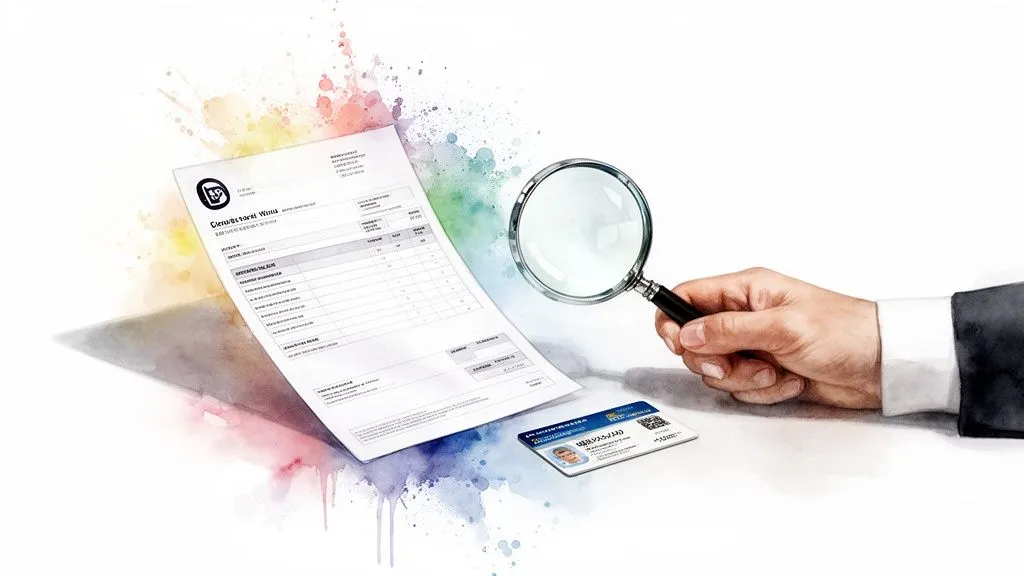
When you receive an invoice from your supplier (for example, for a stock purchase in Germany), one thing should immediately catch your attention: it must be issued excluding VAT (excl. VAT). That’s the starting signal for the reverse charge. But watch out — the devil is in the details, and other elements are just as crucial.
The mentions to check on your suppliers’ invoices
For everything to be in order, a foreign supplier’s invoice subject to the reverse charge must contain very specific information. If any is missing, you expose yourself to risk in the event of an audit.
Here are the points to scrutinize closely:
- Your complete information: Your legal business name, your address and, above all, your French intra-EU VAT number.
- The supplier’s information: Their name, address and their own intra-EU VAT number.
- An explicit mention: The invoice must clearly state that VAT is being reverse-charged. The wording varies, but look for a phrase like “Autoliquidation par le preneur” or its English equivalent “Reverse charge.”
- The legal reference: Invoices will often cite the relevant article of the European directive, for example a reference to article 194 of Directive 2006/112/EC.
Think of your supplier’s invoice as a fiscal passport. If it’s missing a stamp or a key piece of information, crossing the declarative “border” becomes perilous. The “Reverse charge” mention is that indispensable stamp.
Take your Shopify subscription as an example. The invoice issued by their entity (via its Irish branch) clearly states “Reverse Charge” and specifies that VAT must be handled by the customer. It’s a textbook case.
How to invoice your own business customers in the EU
The reverse charge principle works both ways. If you sell a good or service to a VAT-registered business customer (B2B) in another EU country, you must apply the same mechanism, but this time as the seller.
Your invoice must absolutely:
- Be issued without French VAT.
- Mention the intra-EU VAT number of your customer as well as your own.
- Include the “Reverse charge” mention.
This procedure ensures that it’s your customer who will collect and remit VAT in their own country, in accordance with their local regulations.
The VIES habit: a non-negotiable tool
How can you be absolutely certain that your business partner, whether a customer or a supplier, is indeed VAT-registered in their country? Their good faith isn’t enough. The tax authorities will ask you to prove that their intra-EU VAT number was valid at the time of the transaction.
For this, one tool is authoritative: the European Commission’s VIES (VAT Information Exchange System) service. It lets you check the validity of any EU business’s VAT number online, instantly.
Getting into the habit of systematically checking every new partner on VIES before issuing an invoice or applying the reverse charge isn’t just good practice — it’s essential. This simple step protects you and justifies how you handled the VAT. A small click that can save you a lot of trouble.
How do you translate the reverse charge into accounting entries and the CA3 return?
Once your invoices are compliant, it’s time to move to practice. Specifically, how does this reverse charge translate into your books and your VAT return? It’s a precise mechanism, but entirely logical, designed to keep the operation financially neutral for you.
The principle is simple: since you don’t pay VAT to your supplier, it’s up to you to record it in your accounts through a set of entries. Essentially, you’ll simulate both collecting and deducting VAT at the same time. The result: zero impact on your cash flow.
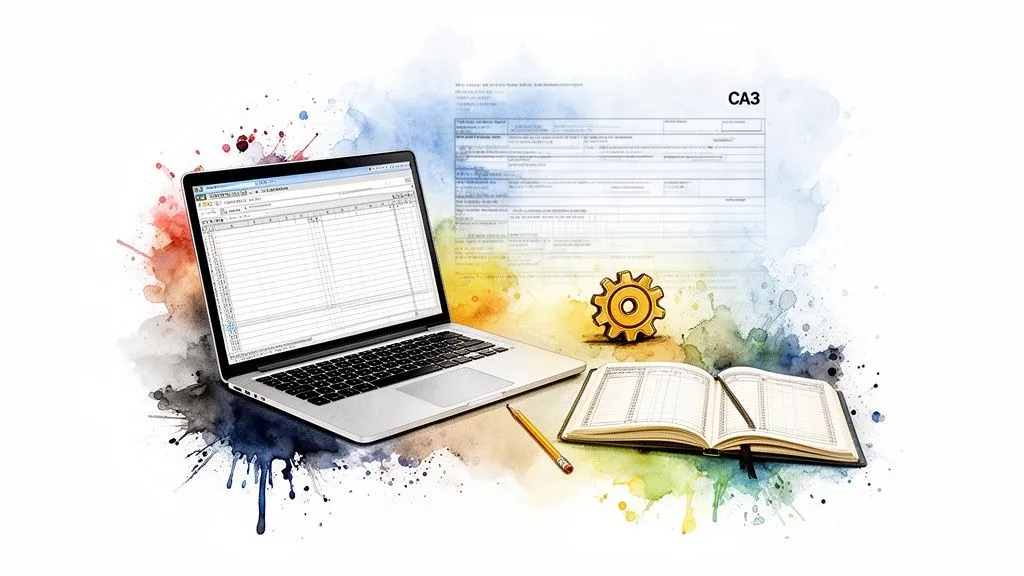
This double entry is the key to correctly recording the VAT reverse charge under article 283 2 in your books. Rigor is essential here.
The accounting entries, step by step
Let’s take a concrete case. Imagine you buy an online advertising service for €1,000 excl. VAT from a provider based in Ireland. The applicable VAT rate in France is 20%.
First, we calculate the theoretical VAT: €1,000 x 20% = €200. Next, we post the following entries in the purchases journal:
- Debit account 623000 “Advertising” for €1,000 (the amount of your expense).
- Debit account 445662 “Deductible intra-EU VAT” for €200 (the VAT you can recover).
- Credit account 401000 “Suppliers” for €1,000 (what you actually owe them).
- Credit account 445200 “Intra-EU VAT due” for €200 (the VAT you “collect” for the State).
The deductible VAT account (445662) and the VAT due account (445200) balance out perfectly. In the end, your debt to the supplier is indeed €1,000, and the VAT operation is a wash. The precision of these entries is crucial, as they form the basis of your return and ensure the transaction is traceable. For more, you can read up on the structure of the French accounting entries file (FEC), essential in the event of an audit.
Think of your accounting as a mirror of reality. The reverse-charge entry simply reflects the mechanism: you collect a VAT amount that you deduct in the same motion. It’s this double effect that makes the operation neutral.
Filling out the CA3 VAT return
Accounting is one thing. Reporting to the tax authorities is another. It’s on the CA3 VAT form that everything becomes concrete. An error on the wrong line can quickly draw attention.
For our €1,000 service purchase, here’s where to report the amounts:
- The excl.-VAT amount of the transaction: First, you declare the €1,000 base. For a service purchased in the EU, this goes on line 03 “Intra-EU acquisitions.”
- The collected VAT: Next, you report that same €1,000 amount in box B. The corresponding VAT (€200) will be automatically calculated and added to your collected VAT on line 08.
- The deductible VAT: Finally, you enter the €200 of VAT in the deductible VAT box, on line 19 “on other goods and services.”
The operation is indeed neutral: you declare €200 of collected VAT and €200 of deductible VAT. The balance is zero.
Automation, your best ally to secure the process
This mechanism, while logical, can quickly become a headache and a source of errors, especially if you handle dozens of foreign supplier invoices every month. One omission, one line swapped, and your entire return can be called into question.
This is where management platforms like Bizyness come in. By connecting to your sales and payment tools, they can automate the entire process. A purchase invoice from Shopify or Google is identified, the reverse-charge entries are generated with no manual input, and your CA3 is pre-filled with the right amounts on the right lines.
This automation eliminates the risk of human error and guarantees ongoing tax compliance. A complex task turns into a simple, secure data flow, freeing up valuable time for you.
Real-world scenarios for online sellers
Let’s move from theory to practice. To really understand the inner workings of the VAT reverse charge under article 283 2, the best approach is to picture situations you deal with every day. Let’s look together at four typical scenarios for an e-commerce seller, breaking down the process, your obligations and the mistakes to avoid.
Scenario 1: You buy stock within the European Union
Imagine you run a Shopify store. You’ve found a great supplier in Italy for your products and place an order for €5,000.
The Italian supplier will first check that your intra-EU VAT number is valid (via the VIES service). Once that check is done, they’ll send you an invoice for €5,000 excl. VAT. That’s crucial. On their invoice, they must include the mention “Reverse charge” or its international equivalent.
On your end, the work begins. You need to reverse-charge French VAT, which is 20%. The calculation is simple: €5,000 x 20% = €1,000. On your VAT return (the famous CA3), you’ll enter this €1,000 in both the collected VAT box and the deductible VAT box. One cancels out the other, so the operation is entirely neutral for your cash flow.
The trap to avoid: Above all, never accept an invoice including VAT from your supplier! If they charge you Italian VAT, they’ve made a mistake. You won’t be able to deduct it in France, and you’ll have to go through often long and painful procedures to get a refund in Italy.
Scenario 2: You pay for digital services and marketplace commissions
This case is probably the most common for you. Think of your advertising spend on Google Ireland, the commissions Amazon Luxembourg charges you, or your monthly Shopify subscription.
Let’s take a concrete example: €500 in advertising fees paid to Meta (Facebook’s parent company, based in Ireland). The invoice you receive will be for €500 excl. VAT, with the mention “Reverse Charge.” Just as with the stock purchase, you apply the French VAT reverse charge of 20% (i.e. €100) directly on your CA3 return.
The mechanism is exactly the same for commissions charged by giants like Amazon. These fees are considered B2B services provided by a foreign company, which automatically triggers the reverse-charge mechanism.
The reverse charge on digital services is an e-commerce seller’s daily bread. Mastering it means ensuring that dozens of small, often automated monthly transactions are perfectly compliant without even having to think about it.
Scenario 3: You import goods from outside the EU (for example, from China)
You’ve found a manufacturer in China and order €10,000 worth of products. This is an import.
Good news: since 1 January 2022, managing import VAT has become much simpler. Previously, you had to advance the VAT to the carrier at customs clearance, then recover it later on your return. Now, the reverse charge is automatic and mandatory.
Specifically, the import VAT (20% on €10,000, i.e. €2,000) is directly pre-filled on your CA3 return. No need to advance a single cent to the carrier anymore. You declare and deduct this amount on the same return, exactly as for a purchase within the EU.
Point to watch: Make sure your French intra-EU VAT number is properly communicated to the carrier and correctly reported on the customs documents (the famous Single Administrative Document - SAD). The slightest error here can block the whole automated process. For flawless document management, feel free to check out our complete guide on creating compliant invoices and quotes.
Scenario 4: You hire a service provider outside the EU
Imagine you hire a web developer based in India to optimize your e-commerce site. Their service costs you €2,000.
Even though the provider is outside the European Union, the reverse-charge mechanism applies. This is indeed a service purchase from a company located outside France. The Indian developer will invoice you €2,000, with no local VAT.
Now it’s your turn: you reverse-charge French VAT of 20% (€400) on your CA3 return. You declare this €400 as collected VAT and, at the same time, deduct it. Once again, the impact on your cash flow is zero.
Summary of VAT regimes for e-commerce operations
To make things clearer, here’s a quick comparison to distinguish between the VAT mechanisms (reverse charge, OSS, IOSS) depending on your usual operations.
| Type of operation | Business partner | Applicable VAT mechanism | Responsible for the return |
|---|---|---|---|
| B2B stock purchase | Supplier in the EU (Italy) | Reverse charge (Article 283 2) | You, on your French CA3 |
| B2B service purchase | EU/non-EU provider (Google, Shopify) | Reverse charge (Article 283 2) | You, on your French CA3 |
| B2B import of goods | Non-EU supplier (China) | Reverse charge (automatic) | You, on your French CA3 |
| B2C sale of goods | Individual customer in the EU | OSS single window | You, via the OSS portal |
| B2C sale of goods < €150 | Individual customer (import) | IOSS single window or import VAT | You, via the IOSS portal |
This table highlights one essential point: the reverse charge applies only to your business purchases (B2B). For your sales to individuals internationally, the rules are entirely different and go through the OSS and IOSS single windows. Confusing the two is a classic mistake that can quickly turn into a tax headache.
How do you avoid penalties and a tax reassessment?
Let’s be clear: ignoring or misapplying the VAT reverse charge rules can cost your e-commerce business dearly. The tax authorities have this mechanism firmly in their sights, and even a good-faith mistake is quickly spotted and penalized.
The most immediate risk is, of course, financial. If you forget to declare an operation under the reverse charge, you’re liable for a 5% penalty on the amount of VAT that should have been reverse-charged. Even though the operation was cash-flow neutral, the penalty is very real. Imagine this penalty applied across dozens, or even hundreds, of transactions… the math adds up fast.
The tax authorities are inflexible on this point. For them, a missed reverse charge is a formal error, a breach of the reporting obligation. The 5% penalty is there as a reminder, regardless of the final impact on the amount of VAT payable.
But the sanctions don’t stop there. Repeated errors are a red flag for the authorities, and can well trigger an in-depth tax audit. And that means a long, stressful process that can easily monopolize your time and energy at the expense of your business.
What the tax authorities scrutinize
During an audit, the inspector won’t just redo your sums. They’ll look for consistency in how you run your business and make sure you’re on top of your obligations.
Here are the points that will systematically be examined closely:
- A solid audit trail: Every reverse-charged operation must be backed by an ironclad invoice that clearly states the transaction falls under this mechanism. No invoice, no reverse charge.
- The validity of VAT numbers: Did you take the trouble to check your European partners’ intra-EU VAT numbers via VIES before carrying out the transaction? This is a requirement, and the authorities will check it.
- Consistency between your returns and your accounts: The amounts you entered on your CA3 returns must match perfectly with your accounting entries and, of course, with the supporting invoices.
The slightest flaw in this triangle (invoice - accounting - return) can be interpreted as culpable negligence, or even attempted fraud.
Automation, your best ally
Given what’s at stake, relying solely on human diligence is a risky bet. The volume of transactions an e-commerce seller handles — software subscriptions, advertising campaigns abroad, intra-EU stock purchases — makes manual tracking not only tedious but especially prone to oversights.
The most reliable solution is to rely on tools designed for this purpose. A platform like Bizyness, for example, can automate the entire process. It scans your invoices, identifies those requiring a reverse charge, posts the correct accounting entries and pre-fills your VAT return, without you having to think about it.
By guaranteeing flawless application of the rules and perfect traceability, automation simply eliminates the risk of human error. It’s the surest way to secure your tax compliance and sleep soundly, safe from penalties and audits.
Your frequently asked questions about the VAT reverse charge
The reverse-charge principle may seem simple, but in practice, there are always specific cases that raise doubts. Let’s untangle together the most common situations you might encounter.
I’m under the VAT exemption scheme (franchise en base), am I affected?
In principle, no. If you benefit from the VAT exemption scheme, you don’t invoice, declare or pay VAT. The reverse-charge entries (collect then deduct) therefore don’t apply, since you don’t file a CA3 return.
Be careful, though, about one significant exception: intra-EU acquisitions. If you buy more than €10,000 worth of goods per year from European suppliers, you switch into the VAT regime just for these operations. You’ll then need an intra-EU VAT number to reverse-charge the tax on these specific purchases.
Reverse charge or single window (OSS): what’s the difference?
They’re often confused, but their roles are radically different. To put it simply:
- The reverse charge applies to your purchases — business-to-business (B2B) purchases made abroad. As the buyer, you’re the one who handles the French VAT.
- The OSS (One-Stop Shop) applies to your sales to individuals (B2C) in other EU countries. It’s a tool that simplifies the reporting of foreign VAT you must collect on behalf of those countries.
Think of it this way: reverse charge = inbound flow (purchases), OSS = outbound flow (B2C EU sales).
Oops, I forgot to reverse-charge the VAT. How do I fix it?
To err is human! If you realize you missed something on a past return, don’t panic, but you do need to correct it. The procedure involves filing an amended VAT return for the period concerned.
You’ll show the VAT you should have collected, as well as the corresponding deductible VAT. The financial impact is zero, but this correction is crucial. Without it, in the event of an audit, you risk a 5% penalty on the amount of VAT omitted.
My foreign supplier charged me VAT by mistake, what should I do?
A classic situation. If an EU supplier sends you an invoice with their country’s VAT even though the conditions for the reverse charge are met, the first move is simple: don’t pay that VAT.
Contact them right away. Explain that the transaction falls under the reverse charge and ask for a corrected invoice with no VAT, which must include your intra-EU VAT number and the “Reverse charge” mention. If you do pay that foreign VAT, you won’t be able to recover it on your French return. You’d then have to launch a long and complicated refund procedure in their country. Better safe than sorry!
Turning the complexity of e-commerce VAT into a simple formality is our mission. Discover Bizyness. Our platform automates VAT management, from invoicing to filing, so you can focus on your growth with total peace of mind. Simplify your financial management at https://www.bizyness.fr.
